
Thymosin Alpha-1: Published Research
A structured bibliographic survey of the Thymosin Alpha-1 research record, from the 1970s discovery work through chronic-hepatitis randomized trials, TLR-pathway immunomodulation studies, and contemporary immuno-oncology review literature. Educational reference.
For research use only. Not for human consumption. This article is educational reference material. It is not medical advice and is not a recommendation to use any substance.
Introduction
Thymosin Alpha-1 (Tα1) occupies an unusual position in the peptide research landscape. It is a 28-amino-acid acetylated peptide first isolated from thymic tissue in the 1970s, and it accumulated a formal clinical research record over the following four decades in a way that most non-FDA-approved research peptides never approached. That record is uneven in quality and scattered across several therapeutic areas, which makes a plain bibliographic map more useful to a researcher than a narrative that flattens the differences between study designs.
This article surveys the Tα1 literature by grouping it around the questions individual research programs were actually built to answer: how the peptide was characterized biochemically, what the chronic-hepatitis randomized trials measured, how the immunomodulation mechanism was investigated in laboratory models, and how contemporary review literature has re-framed the peptide for the immuno-oncology era. The molecular pharmacology underlying these studies is treated separately in the Thymosin Alpha-1 mechanism of action article, and the peptide's isolation and naming are covered in the Thymosin Alpha-1 discovery and regulatory history article.
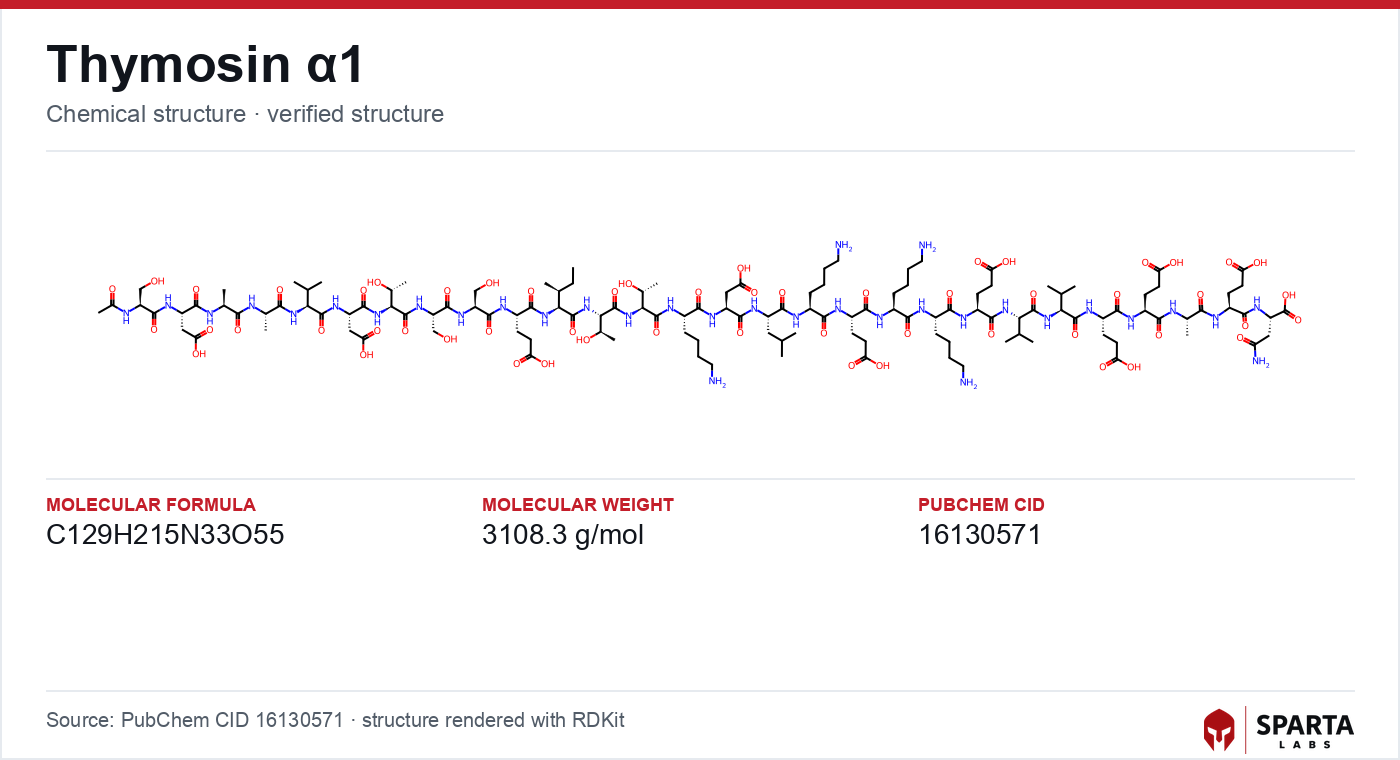
Figure: chemical structure of Thymosin Alpha-1.
Reading the Tα1 Literature by Study Design
Before summarizing findings it is worth separating the Tα1 literature into its component study types, because the strength of any statement about the peptide depends heavily on which design produced it.
Biochemical and isolation work. The earliest publications, associated with Allan Goldstein and colleagues, described the fractionation of thymosin fraction 5 and the sequencing of the Tα1 polypeptide. These are characterization papers, not efficacy studies; their value is in defining what the molecule is.
Randomized controlled trials (RCTs). The chronic-hepatitis-B program produced the largest cluster of controlled Tα1 trials. These generally compared Tα1, alone or with interferon-alpha, against interferon or placebo, using virological and serological response endpoints.
Mechanistic laboratory studies. A separate body of work, much of it in murine and in-vitro models, investigated how Tα1 engages innate-immune signaling, in particular Toll-like receptor (TLR) pathways and dendritic-cell maturation. This is where the pharmacological rationale for the clinical work was developed.
Narrative and systematic reviews. Because the primary literature is heterogeneous, review articles carry disproportionate weight in how the field is understood. Reviews should be read as syntheses that reflect their authors' inclusion choices, not as new evidence.
Findings from research models do not establish safety or efficacy in humans. Sparta Labs makes no claims about the use of this compound.
Chronic Hepatitis B: The Controlled-Trial Core
The chronic-hepatitis-B literature is the most methodologically rigorous portion of the Tα1 record because it is where randomized designs were concentrated.
A frequently cited randomized controlled trial by Chien, Liaw, and colleagues, published in Hepatology in 1998, studied synthetic Tα1 in patients with hepatitis B e antigen (HBeAg)-positive chronic hepatitis B [1]. The trial used serological and virological response endpoints, including HBeAg seroconversion and hepatitis B viral DNA status, and reported response rates in the Tα1 arm that were broadly comparable to an interferon-alpha comparator. The trial is one of the studies most often referenced when the international regulatory approvals for thymalfasin are discussed.
The relevance of this trial to a researcher is less about any single percentage and more about design: it established HBeAg seroconversion as the operative endpoint for Tα1 hepatitis work and set the comparative frame (Tα1 measured against interferon rather than against no treatment) that later combination-therapy studies inherited.
Chronic Hepatitis C: A Contrasting Result
The hepatitis-C literature is instructive precisely because it did not mirror the hepatitis-B results, and that contrast shaped later trial design.
A double-blind, placebo-controlled study by Sherman and colleagues, published in Hepatology in 1998, evaluated Tα1 in combination with interferon in patients with chronic hepatitis C [2]. The design tested the hypothesis that Tα1's immunomodulatory profile might complement rather than replace antiviral therapy, reflecting a broader shift in the field away from monotherapy framing. Read alongside the hepatitis-B program, this study illustrates a recurring theme in the Tα1 corpus: reported outcomes were sensitive to disease context, comparator, and whether the peptide was studied alone or as an adjunct.
The Immunomodulation Mechanism Studies
The clinical trials were built on a laboratory foundation that treated Tα1 as an innate-immune modulator rather than a direct antiviral agent.
Work associated with Luigina Romani and collaborators characterized Tα1 as an activator of dendritic cells through Toll-like-receptor signaling, providing a molecular framework in which the peptide influences the maturation and polarization of antigen-presenting cells rather than acting on pathogens directly [3]. This TLR/dendritic-cell model is the mechanistic thread that connects the antiviral and oncology research programs; it is the reason investigators repeatedly hypothesized activity in settings characterized by impaired cell-mediated immunity.
Foundational review work by Garaci and colleagues situated these mechanistic findings within the broader thymic-peptide field and traced the line from thymosin fraction 5 to the isolated Tα1 polypeptide and its reported immunological activities [4]. Reviews of this kind are the connective tissue of the Tα1 literature, and the mechanistic reasoning they consolidate is examined in more depth in the Thymosin Alpha-1 research overview.
Contemporary Review Literature and the Immuno-Oncology Reframing
The most recent phase of Tα1 publishing has reinterpreted the historical dataset through the lens of modern tumor immunology.
A 2023 review by Liu and colleagues in Frontiers in Pharmacology surveyed Tα1's accumulated research and argued for reconsidering the peptide in the context of checkpoint-inhibitor immunotherapy [5]. The authors framed the TLR9 and dendritic-cell mechanism established in the earlier laboratory literature as a rationale for investigating Tα1 alongside contemporary immuno-oncology agents, describing this as a reimagined research direction distinct from the peptide's original antiviral emphasis. As a review, it does not report new trial data; its contribution is a synthesis that re-links the older mechanistic work to a new set of research questions.
This immuno-oncology framing is where much of the contemporary research interest in Tα1 currently sits, and it is a clear example of how a decades-old immunomodulator can be re-situated as adjacent fields advance.
Analytical characterization of research-grade material relevant to studies of this kind is discussed in the Thymosin Alpha-1 sourcing and quality article, and reference material with third-party analytical documentation is catalogued on the Thymosin Alpha-1 product page. For a structurally distinct healing-adjacent peptide with its own separate literature, see TB-500 published research.
Knowledge Gaps
Several gaps recur across the Tα1 record and define where the literature is thinnest.
First, much of the modern non-hepatitis clinical signal derives from retrospective and observational designs rather than randomized trials, which limits causal inference. Second, the bridge between the murine TLR/dendritic-cell mechanism and human clinical endpoints remains an inference rather than a directly demonstrated chain. Third, the immuno-oncology hypothesis articulated in recent reviews is, as of the current literature, a rationale for prospective investigation rather than a conclusion drawn from completed combination trials. A researcher reading this corpus should weight the randomized hepatitis trials and the mechanistic laboratory work more heavily than the observational and review layers built on top of them.
References
-
Chien RN, Liaw YF, Chen TC, Yeh CT, Sheen IS. Efficacy of thymosin alpha1 in patients with chronic hepatitis B: a randomized, controlled trial. Hepatology. 1998;27(5):1383–1387. PMID: 9581695. View on PubMed
-
Sherman KE, Sjogren M, Creager RL, Damiano MA, Freeman S, Lewey S, et al. Combination therapy with thymosin alpha1 and interferon for the treatment of chronic hepatitis C infection: a randomized, placebo-controlled double-blind trial. Hepatology. 1998;27(4):1128–1135. PMID: 9537455. View on PubMed
-
Romani L, Bistoni F, Gaziano R, Bozza S, Montagnoli C, Perruccio K, et al. Thymosin alpha 1 activates dendritic cells for antifungal Th1 resistance through toll-like receptor signaling. Blood. 2004;103(11):4232–4239. PMID: 14982877. View on PubMed
-
Garaci E, Pica F, Rasi G, Favalli C. Thymosin alpha 1 in the treatment of cancer: from basic research to clinical application. Int J Immunopharmacol. 2000;22(12):1067–1076. PMID: 11137613. View on PubMed
-
Liu Y, Dong Y, Kong L, Shi F, Zhu H, Yu J. Thymosin alpha 1 reimagine its broader applications in the immuno-oncology era. Front Pharmacol. 2023;14:1110765. PMID: 36871535. DOI: 10.3389/fphar.2023.1110765. View on PubMed
Disclaimer. Statements in this article have not been evaluated by the Food and Drug Administration. This compound is not intended to diagnose, treat, cure, or prevent any disease. Sparta Labs sells research-use-only materials. Content is provided for educational and informational purposes only and does not constitute medical advice. Consult a qualified medical professional for any health concerns.
Frequently asked questions
What types of studies make up the Thymosin Alpha-1 research record?
The literature spans biochemical isolation and sequencing work from the 1970s, randomized controlled trials concentrated in chronic hepatitis B, mechanistic laboratory studies of Toll-like-receptor and dendritic-cell signaling, and narrative and systematic reviews. The randomized hepatitis trials and the mechanistic laboratory work are generally the most methodologically robust portions of the record.
What did the randomized chronic-hepatitis-B trials of Thymosin Alpha-1 examine?
A 1998 randomized controlled trial by Chien, Liaw, and colleagues published in Hepatology studied synthetic Thymosin Alpha-1 in HBeAg-positive chronic hepatitis B, using serological and virological endpoints such as HBeAg seroconversion and viral DNA status, and compared it against an interferon-alpha arm. The trial established the comparative framing that later combination-therapy studies inherited.
How did the hepatitis C research differ from the hepatitis B research?
The hepatitis C literature examined Thymosin Alpha-1 in combination with interferon, testing whether the peptide's immunomodulatory profile might complement antiviral therapy rather than replace it. Read alongside the hepatitis B program, this illustrates that reported outcomes in the Thymosin Alpha-1 corpus were sensitive to disease context, comparator, and whether the peptide was studied alone or as an adjunct.
How is Thymosin Alpha-1 described in recent immuno-oncology reviews?
A 2023 review by Liu and colleagues in Frontiers in Pharmacology reconsidered the accumulated Thymosin Alpha-1 research in the context of checkpoint-inhibitor immunotherapy, framing the previously established Toll-like-receptor and dendritic-cell mechanism as a rationale for investigating the peptide alongside modern immuno-oncology agents. As a review it synthesizes existing work rather than reporting new trial data.