
Thymosin Alpha-1: Discovery and Regulatory History
How a partially purified calf-thymus extract named in 1966 became a sequenced 28-residue peptide, a globally approved hepatitis drug, and a 2024 FDA compounding-review subject: the documented history of Thymosin Alpha-1. Educational reference.
For research use only. Not for human consumption. This article is educational reference material. It is not medical advice and is not a recommendation to use any substance.
Introduction
Thymosin Alpha-1 (Tα1) is a 28-amino-acid, N-terminally acetylated, highly acidic peptide whose recorded history spans roughly six decades. Its lineage begins not with a single molecule but with a research program that first had to establish that the thymus gland behaves as an endocrine organ at all. From that premise, a partially purified calf-thymus extract named in 1966 was progressively fractionated until one component was resolved, sequenced in 1977, and eventually developed commercially as the synthetic drug thymalfasin (trade name Zadaxin). This article traces that documented arc, drawing on primary literature and regulatory records, and treats the compound as a subject of scientific and regulatory history rather than of use. Readers interested in the reported molecular pharmacology can consult the Thymosin Alpha-1 mechanism of action article, while synthesis and analytical detail on the current research-grade form appears in the Thymosin Alpha-1 sourcing and quality article.
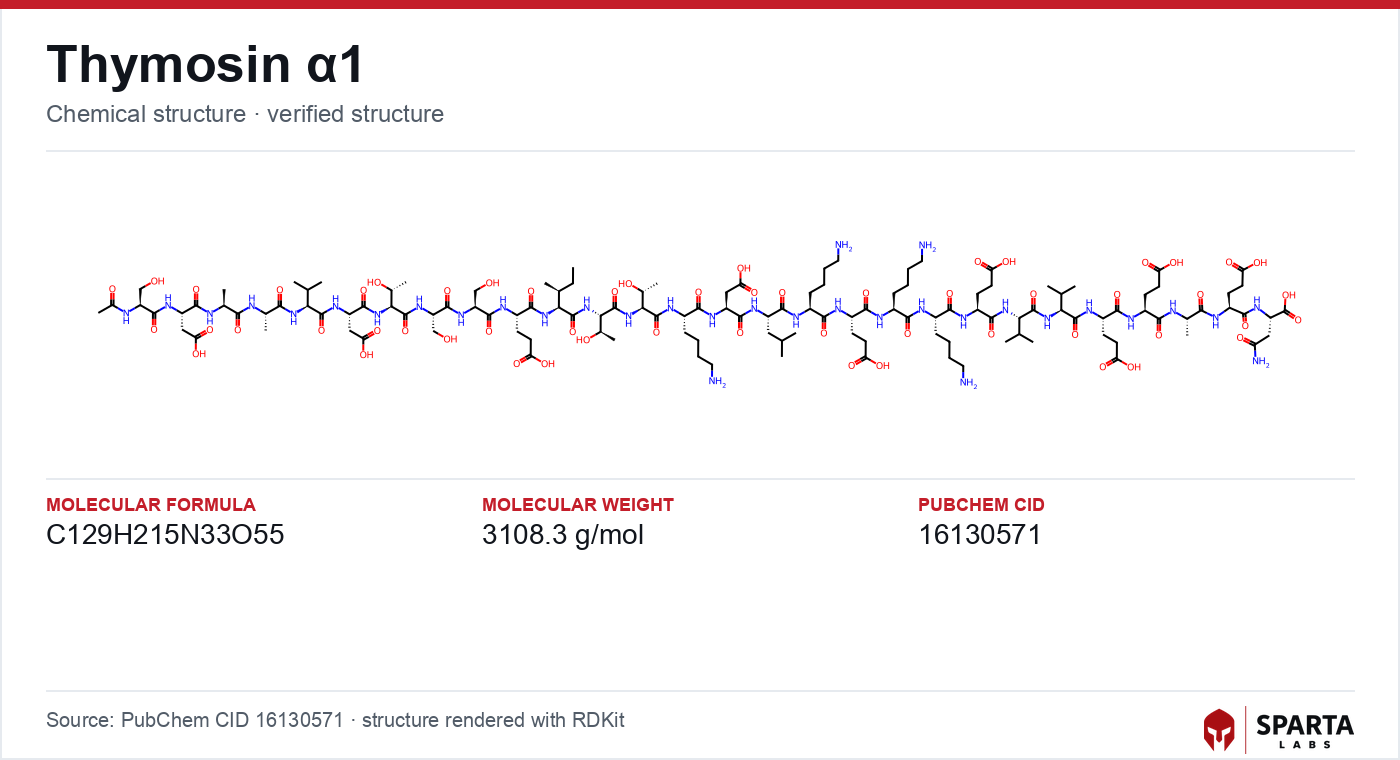
Figure: chemical structure of Thymosin α1.
From Lymphoid Tissue to Endocrine Organ: The 1960s Premise
The intellectual precondition for the Tα1 discovery was a reappraisal of what the thymus does. Through the first half of the twentieth century the thymus was understood mainly as lymphoid tissue of uncertain function. In the early 1960s, cellular immunology work by Jacques Miller and others established the organ's role in producing immunologically competent T lymphocytes, reframing it as central to adaptive immunity.
Working in parallel with that cellular picture, the laboratory of Abraham White and Allan L. Goldstein at the Albert Einstein College of Medicine pursued a distinct question: whether the thymus secreted soluble factors that could modulate lymphocyte function independently of cell-to-cell contact. This endocrine framing is what set the stage for isolating a defined thymic peptide.
In 1966, Goldstein, Slater, and White published in the Proceedings of the National Academy of Sciences USA the first systematic description of a thymic-derived preparation capable of influencing lymphocyte populations, and they named it "thymosin" [1]. At that point thymosin was a partially purified bovine-thymus extract, not a single molecule. The paper reported that this preparation restored certain immunological parameters in animal models of thymic deficiency.
Findings from research models do not establish safety or efficacy in humans. Sparta Labs makes no claims about the use of this compound.
That 1966 report supplied both the terminology and the biological rationale that drove the next decade of purification.
Resolving a Single Peptide: The Fraction-5 Program (1966–1974)
Naming a crude extract is not the same as isolating a molecule. Following the 1966 publication, the Goldstein group undertook a systematic biochemical fractionation of bovine thymus tissue to separate the individual species contained within the crude preparation. This effort moved with the investigators across institutions, first to the University of Texas Medical Branch at Galveston and later to George Washington University.
By the early 1970s the group had produced a preparation designated "thymosin fraction 5," a heat-stable, partially purified calf-thymus extract containing at least a dozen discrete acidic peptides and polypeptides. Fraction 5 became a widely used reference material in preclinical biological testing during this period and served as the reservoir from which individual peptides were subsequently resolved.
A 2007 narrative history by Goldstein and Goldstein in Annals of the New York Academy of Sciences recounted this fractionation program and noted that the individual molecular components were labeled with Greek-letter prefixes reflecting their electrophoretic mobility [2]. The alpha-1 designation is a direct artifact of that naming scheme, situating the peptide within an ordered family rather than treating it as an isolated discovery.
The Defining Event: Sequence Determination in 1977
The pivotal moment in the compound's history was structural. In 1977, Goldstein, Low, McAdoo, McClure, Thurman, Rossio, and colleagues published in the Proceedings of the National Academy of Sciences USA (PMID 265536) the complete amino acid sequence of thymosin alpha-1 for the first time [3]. The paper characterized Tα1 as a 28-residue, heat-stable, highly acidic peptide bearing an N-terminal acetyl group, and reported biological activity in lymphocyte-differentiation assays.
This sequence determination is what converted a fraction-5 band into a defined, reproducible chemical entity, and it anchors essentially all subsequent Tα1 research and manufacturing. A complementary 1979 paper by Low, Thurman, McAdoo, McClure, Rossio, Naylor, and Goldstein in the Journal of Biological Chemistry (PMID 216684) supplied detailed isolation protocols and characterization data for both thymosin alpha-1 and polypeptide beta-1 from calf thymus, completing the foundational biochemical description [4].
Tracing the Biosynthetic Origin: Prothymosin Alpha (1984)
A distinct strand of the history concerns where the naturally occurring peptide comes from inside the cell. Through the late 1970s and 1980s the Goldstein group at George Washington University examined the gene and precursor protein associated with Tα1 biosynthesis. A 1984 paper by Haritos and colleagues (PMC344752) identified prothymosin alpha as the larger precursor from which Tα1 is derived by post-translational processing [5].
This finding reframed Tα1 not as a directly transcribed product but as a processed fragment of a longer molecule, a point of ongoing biochemical interest that separates the naturally generated peptide from the synthetic form used in research today.
The Commercial Pathway: SciClone, Thymalfasin, and Zadaxin
Historically, translation from laboratory peptide to regulated drug proceeded through a single commercial sponsor. SciClone Pharmaceuticals acquired the licensing rights to develop and commercialize the synthetic form, thymalfasin, under the trade name Zadaxin, and conducted the clinical-trial programs supporting regulatory submissions outside the United States. A 2002 clinical-pharmacology review in Current Opinion in Investigational Drugs by Billich described thymalfasin's development and approval status across Asia, Latin America, and the Middle East as of that date [7].
Zadaxin received one of its earliest major approvals in Italy in 1993 for hepatitis B. Approvals followed across multiple Asian markets, concentrated in Southeast Asia, through the late 1990s and 2000s. By the time of later summary reviews, the compound was reported as approved in more than 30 countries, with hepatitis B as the principal approved indication and hepatitis C added in a subset of markets [6]. This footprint placed Tα1 among the more broadly approved thymic peptides in clinical use outside the United States.
The US Regulatory Record: Orphan Designations and the 2024 Compounding Review
The compound's regulatory position within the United States has been distinct from its international commercial status. Under the Orphan Drug Act of 1983, the FDA granted orphan-drug designation to thymalfasin for several indications, including chronic active hepatitis B, malignant melanoma, DiGeorge anomaly with immune defects, and hepatocellular carcinoma, as documented in regulatory records and published reviews [6]. Orphan designation confers development incentives such as fee waivers and potential market exclusivity, but it is not itself a marketing authorization. The European Medicines Agency separately granted Zadaxin orphan designation for hepatocellular carcinoma.
In 2024, the FDA's Pharmacy Compounding Advisory Committee (PCAC) formally reviewed thymosin alpha-1 among bulk drug substances nominated for the 503B compounding list [8]. The FDA briefing document for that review summarized the available clinical data, regulatory history, and scientific rationale relevant to the compounding evaluation. This review is the most recent significant regulatory event in the compound's US history and is a useful reference point for anyone tracking its formal status.
A Mechanistic Second Act: TLR9, Dendritic Cells, and the COVID-Era Data Expansion
The scientific history of Tα1 did not stop with hepatitis. Two later developments reshaped its research profile. First, mechanistic work by Romani and colleagues at the University of Perugia in 2006 and 2007 reframed the compound's reported pharmacology in terms of TLR9- and TLR2-dependent dendritic-cell activation [9,10]. This molecular reframing connected a peptide first characterized in the 1970s to contemporary innate-immunity research and informed subsequent study designs, including efforts to target patient subgroups defined by TLR-pathway relevance.
Second, the COVID-19 pandemic generated a substantial body of clinical observational data from China, where Zadaxin was already approved and in use. Between 2020 and 2022 this literature underwent peer review and meta-analytic synthesis, extending the compound's published record into the critical-illness domain and identifying subgroup signals, particularly among lymphocytopenic critically ill patients [6]. A 2023 review in Frontiers in Pharmacology by Liu and colleagues then examined Tα1's potential positioning within immuno-oncology research, describing a program grounded in the TLR9/dendritic-cell framework [11].
Taken together, the arc runs from the 1966 naming of a crude extract to sequence determination in the 1970s, clinical translation and broad international approval in the 1990s, mechanistic reframing in the 2000s, and renewed data expansion into the 2020s. A comparable thymic-derived trajectory is documented in the TB-500 discovery history, which follows the synthetic analog of Thymosin Beta-4, while the Epithalon discovery history offers a parallel case in the peptide-and-aging research literature. Broader classification and chemistry appear in the Thymosin Alpha-1 research overview. Research-grade Thymosin Alpha-1 from Sparta Labs is synthesized via solid-phase peptide synthesis and released against third-party analytical specifications.
References
-
Goldstein AL, Slater FD, White A. Preparation, assay, and partial purification of a thymic lymphocytopoietic factor (thymosin). Proc Natl Acad Sci USA. 1966;56(3):1010–1017. PMID: 5230175. View on PubMed
-
Goldstein AL, Goldstein AL. History of the discovery of the thymosins. Ann N Y Acad Sci. 2007;1112:1–13. PMID: 17600284. DOI: 10.1196/annals.1415.001. View on PubMed
-
Goldstein AL, Low TL, McAdoo M, McClure J, Thurman GB, Rossio J, et al. Thymosin alpha1: isolation and sequence analysis of an immunologically active thymic polypeptide. Proc Natl Acad Sci USA. 1977;74(2):725–729. PMID: 265536. PMC392366. Full text on PMC
-
Low TL, Thurman GB, McAdoo M, McClure J, Rossio JL, Naylor PH, Goldstein AL. The chemistry and biology of thymosin. I. Isolation, characterization, and biological activities of thymosin alpha1 and polypeptide beta1 from calf thymus. J Biol Chem. 1979;254(3):981–986. PMID: 216684. View on PubMed
-
Haritos AA, Goodall GJ, Horecker BL. Prothymosin alpha: isolation and properties of the major immunoreactive form of thymosin alpha 1 in rat thymus. Proc Natl Acad Sci USA. 1984;81(4):1008–1011. PMC344752. Full text on PMC
-
Dominari A, Hathaway D 3rd, Pandav K, Vasan S, Dhindsa DS, Dave K, et al. Thymosin alpha 1: A comprehensive review of the literature. World J Virol. 2020;9(5):67–78. PMID: 33362999. PMC7747025. DOI: 10.5501/wjv.v9.i5.67. Full text on PMC
-
Billich A. Thymosin alpha1. SciClone Pharmaceuticals. Curr Opin Investig Drugs. 2002;3(5):698–707. PMID: 12090542. View on PubMed
-
U.S. Food and Drug Administration. Pharmacy Compounding Advisory Committee (PCAC) Meeting: Thymosin Alpha-1 (Tα1) Related Bulk Drug Substances. FDA Briefing Document. 2024. Source: fda.gov
-
Romani L, Bistoni F, Gaziano R, Bozza S, Montagnoli C, Perruccio K, et al. Thymosin alpha 1 activates dendritic cell tryptophan catabolism and establishes a regulatory environment for balance of inflammation and tolerance. Blood. 2006;108(7):2265–2274. PMID: 16741252. DOI: 10.1182/blood-2006-02-004762. View on PubMed
-
Romani L, Bistoni F, Montagnoli C, Gaziano R, Bozza S, Fallarino F, et al. Thymosin alpha1 activates the TLR9/MyD88/IRF7-dependent murine cytomegalovirus sensing for induction of anti-viral responses in vivo. Int Immunol. 2007;19(10):1261–1271. PMID: 17804687. DOI: 10.1093/intimm/dxm099. View on PubMed
-
Liu Y, Dong Y, Kong L, Shi F, Zhu H, Yu J. Thymosin alpha 1: reimagine its broader applications in the immuno-oncology era. Front Pharmacol. 2023;14:1110765. PMID: 36871535. DOI: 10.3389/fphar.2023.1110765. View on PubMed
Disclaimer. Statements in this article have not been evaluated by the Food and Drug Administration. This compound is not intended to diagnose, treat, cure, or prevent any disease. Sparta Labs sells research-use-only materials. Content is provided for educational and informational purposes only and does not constitute medical advice. Consult a qualified medical professional for any health concerns.
Frequently asked questions
Who first named thymosin, and how did Thymosin Alpha-1 emerge from it?
The term thymosin was introduced in 1966 by Goldstein, Slater, and White, who described a partially purified bovine-thymus preparation influencing lymphocyte populations. Thymosin Alpha-1 was later resolved as one discrete peptide within that mixture, with its complete 28-residue sequence first reported in a 1977 paper by Goldstein and colleagues in the Proceedings of the National Academy of Sciences USA.
What was thymosin fraction 5?
Thymosin fraction 5 was a heat-stable, partially purified calf-thymus preparation developed by the Goldstein group in the early 1970s. It contained at least a dozen discrete acidic peptides, which were labeled with Greek-letter prefixes reflecting their electrophoretic mobility. Fraction 5 served as the source material from which Thymosin Alpha-1 was individually isolated and characterized.
What is the relationship between Thymosin Alpha-1 and prothymosin alpha?
Prothymosin alpha is the larger precursor protein from which the naturally occurring Thymosin Alpha-1 peptide is generated through post-translational processing. This biosynthetic relationship was reported by Haritos and colleagues in 1984, clarifying that the 28-residue peptide is a processed fragment rather than a directly transcribed gene product.
What is the regulatory status of Thymosin Alpha-1 in the United States?
The synthetic form, thymalfasin, received multiple FDA orphan-drug designations for indications including chronic active hepatitis B, malignant melanoma, DiGeorge anomaly, and hepatocellular carcinoma, but these designations are development incentives rather than marketing authorizations. In 2024, the FDA's Pharmacy Compounding Advisory Committee reviewed thymosin alpha-1 among bulk drug substances nominated for the 503B compounding list.
How did Thymosin Alpha-1 become internationally approved as Zadaxin?
SciClone Pharmaceuticals licensed thymalfasin and ran the clinical programs supporting submissions outside the United States, marketing the compound as Zadaxin. It received its earliest major approval in Italy in 1993 for hepatitis B and was subsequently reported as approved in more than 30 countries, with hepatitis B as the principal approved indication.