
Thymosin Alpha-1: A Research Overview
A research-library overview of Thymosin Alpha-1 (Tα1 / thymalfasin / Zadaxin): its fraction-5 isolation lineage, acidic 28-residue chemistry and NMR-reported structure, TLR9/dendritic-cell pharmacology, and divergent regulatory footprint. Educational reference.
For research use only. Not for human consumption. This article is educational reference material. It is not medical advice and is not a recommendation to use any substance.
From thymic fraction to a defined 28-residue peptide
Thymosin Alpha-1 (Tα1), catalogued in pharmaceutical settings as thymalfasin and marketed under the trade name Zadaxin, is a 28-amino-acid acetylated peptide that was originally resolved from bovine thymic tissue. It occupies an unusual position in the peptide research literature: unlike many compounds discussed in this library, Tα1 emerged not as a synthetic design target but as a purified fragment of a biological extract, and its identity was established across a decade of progressive fractionation rather than in a single synthesis paper. Its research record spans virology, oncology, and critical-care investigation, and it carries regulatory recognition in numerous jurisdictions outside the United States.
This overview traces the compound along four axes that make it specific: the fraction-to-molecule isolation history, its acidic 28-residue chemistry and reported solution structure, the shift from a vague "immune modulator" label to a defined Toll-like-receptor (TLR) pharmacology, and its divergent regulatory footprint. Readers looking for the receptor-level detail behind the classification below will find it developed in the Thymosin Alpha-1 mechanism of action article; the full timeline of approvals and orphan designations is set out in the Thymosin Alpha-1 discovery and regulatory history reference.
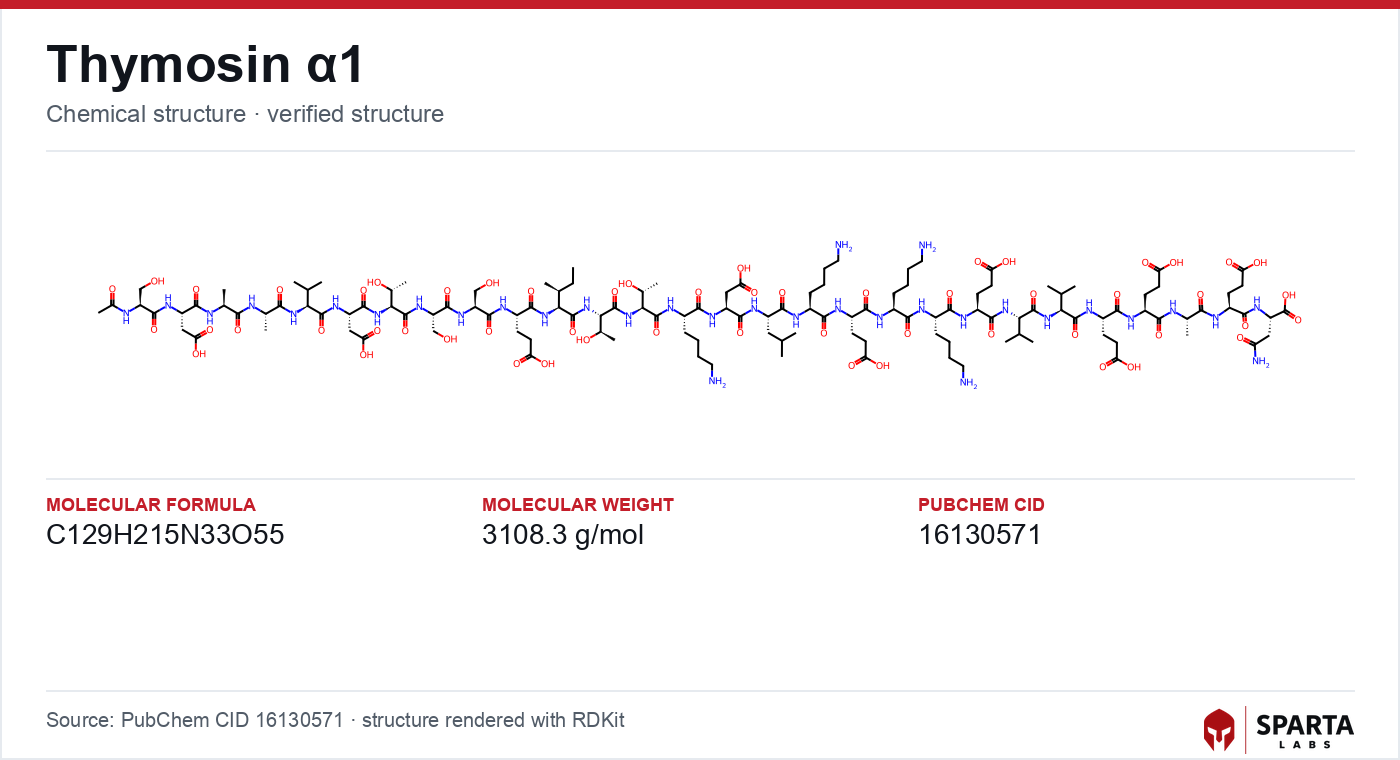
Figure: chemical structure of Thymosin α1.
The fractionation lineage: thymosin fraction 5 to Tα1
Research interest in thymosin-family peptides began in the early 1960s in work initiated at the Albert Einstein College of Medicine under Abraham White, then extended by Allan L. Goldstein, who carried the program to the University of Texas Medical Branch at Galveston and later to George Washington University. The 1966 report by Goldstein, Slater, and White in the Proceedings of the National Academy of Sciences USA first named "thymosin" as a class of thymic polypeptides and described a partially purified lymphocytopoietic preparation [1].
The program advanced in two distinguishable phases. The first produced "thymosin fraction 5," a partially purified calf-thymus preparation containing multiple heat-stable acidic peptides. The second resolved that mixture into discrete molecular species, of which Tα1 became the most thoroughly characterized [4]. This provenance matters for how the compound is read today: many early biological observations were made on the crude fraction, and only later work assigned specific activities to the isolated 28-residue molecule.
Findings from research models do not establish safety or efficacy in humans. Sparta Labs makes no claims about the use of this compound.
A 2007 narrative review by Goldstein and Goldstein in Annals of the New York Academy of Sciences documented this lineage from the 1966 naming through later clinical development under the SciClone Pharmaceuticals banner [2]. A 2020 review by Dominari and colleagues in the World Journal of Virology surveyed the published clinical literature and described Tα1 as the most thoroughly investigated peptide derived from the fraction 5 isolation program [3].
Acidic chemistry and reported solution structure
Thymosin Alpha-1 has the primary sequence Ac-Ser-Asp-Ala-Ala-Val-Asp-Thr-Ser-Ser-Glu-Ile-Thr-Thr-Lys-Asp-Leu-Lys-Glu-Lys-Lys-Glu-Val-Val-Glu-Glu-Ala-Glu-Asn, where "Ac" denotes an N-terminal acetyl group. Its molecular weight is approximately 3,108 daltons, and its high proportion of glutamate and aspartate residues gives it an isoelectric point near pH 4.2, marking it as a strongly acidic peptide.
The seminal 1977 paper by Goldstein and colleagues in PNAS first reported the complete primary sequence and noted that Tα1 was both heat-stable and highly acidic, physicochemical properties that distinguished it from many biologically active peptides and that aided its separation from fraction 5 [4]. These same properties inform how the isolated compound is handled analytically, a topic developed in the Thymosin Alpha-1 sourcing and verification reference.
The molecule's conformation was later examined directly. A 2011 nuclear magnetic resonance (NMR) study by Elizondo-Riojas and colleagues in Biochemical and Biophysical Research Communications characterized human Tα1 in a membrane-mimicking environment and reported two stable structural regions: an alpha-helix spanning approximately residues 14 to 26, and a distorted helical arrangement formed by two double β-turns across the N-terminal twelve residues [5]. The authors noted this organization as potentially relevant to reported interactions with membrane-associated receptor complexes. The synthetic material used in research and in approved pharmaceutical preparations, thymalfasin, is described as identical in sequence and N-terminal acetylation to the tissue-derived peptide and is produced by solid-phase peptide synthesis.
From "immune modulator" to a defined TLR pharmacology
The pharmacological classification of Tα1 has sharpened considerably over its research history. Clinical trial publications from the 1990s and early 2000s frequently described the peptide as a broadly acting "immune modulator," language that reflects the vocabulary of that period rather than a mechanistically precise assignment. Contemporary reviews distinguish this earlier terminology from a more specific framework.
Since 2006, the dominant paradigm in the literature has characterized Tα1 as a Toll-like receptor (TLR) pathway modulator with reported activity at plasmacytoid dendritic cells (pDCs) and myeloid dendritic cells (mDCs). Work by Romani and colleagues, including a 2006 study in Blood and a 2007 study in International Immunology, identified TLR9-dependent and TLR2-dependent signaling as the molecular pharmacology underlying the peptide's reported effects on interferon production and tryptophan catabolism [6,7]. This TLR9/dendritic-cell framing now provides a molecularly specific reference point for the compound's classification.
For comparative context within the research library, other tissue-derived peptides investigated in overlapping immune and repair-oriented contexts include TB-500, whose published literature centers on a distinct actin-sequestration mechanism rather than TLR signaling. Placing Tα1 alongside such compounds highlights how differently defined the two mechanistic accounts are.
A divergent regulatory footprint
Thymalfasin (Zadaxin) has received regulatory approval in numerous countries, with indications that vary by jurisdiction but have centered on hepatitis B and, in some markets, hepatitis C and hepatocellular carcinoma. This international footprint, concentrated in Asia, Latin America, and Eastern Europe, reflects clinical trial programs conducted largely from the 1990s through the 2010s [3].
The United States picture differs. The FDA has granted orphan-drug designation to thymalfasin for several conditions, including chronic active hepatitis B, malignant melanoma, DiGeorge anomaly with immune defects, and hepatocellular carcinoma, as documented in regulatory records and summarized in published reviews [3]. Orphan-drug designation under the Orphan Drug Act of 1983 confers development incentives and does not constitute marketing authorization. In 2024, the FDA's Pharmacy Compounding Advisory Committee (PCAC) reviewed bulk drug substances nominated for the 503B compounding list, placing Tα1 under formal regulatory review in the US context [8]. A comparison of studies underpinning these regulatory decisions is compiled in the Thymosin Alpha-1 published research summary.
Notes on the isolation and development record
The identity of Tα1 rests on a documented sequence of publications. The 1977 PNAS paper (PMID 265536) reported the complete amino acid sequence for the first time, establishing Tα1 as a distinct 28-residue peptide within the fraction 5 mixture [4]. A complementary 1979 paper by Low and colleagues in the Journal of Biological Chemistry (PMID 216684) provided detailed isolation, characterization, and biological-activity data for both thymosin alpha1 and polypeptide beta1 from calf thymus [9].
SciClone Pharmaceuticals subsequently licensed and advanced thymalfasin through clinical development, with its early regulatory approvals arriving in Asia during the 1990s; a 2002 clinical pharmacology review in Expert Opinion on Investigational Drugs summarized that program [10]. Research-grade Thymosin Alpha-1 offered by Sparta Labs is accompanied by independent third-party analysis.
The compound's regulatory timeline is covered in thymosin alpha-1: history, and a study-by-study bibliography in thymosin alpha-1: published research.
References
-
Goldstein AL, Slater FD, White A. Preparation, assay, and partial purification of a thymic lymphocytopoietic factor (thymosin). Proc Natl Acad Sci USA. 1966;56(3):1010–1017. PMID: 5230175. View on PubMed
-
Goldstein AL, Goldstein AL. History of the discovery of the thymosins. Ann N Y Acad Sci. 2007;1112:1–13. PMID: 17600284. DOI: 10.1196/annals.1415.001. View on PubMed
-
Dominari A, Hathaway D 3rd, Pandav K, Vasan S, Dhindsa DS, Dave K, et al. Thymosin alpha 1: A comprehensive review of the literature. World J Virol. 2020;9(5):67–78. PMID: 33362999. PMC7747025. DOI: 10.5501/wjv.v9.i5.67. Full text on PMC
-
Goldstein AL, Low TL, McAdoo M, McClure J, Thurman GB, Rossio J, et al. Thymosin alpha1: isolation and sequence analysis of an immunologically active thymic polypeptide. Proc Natl Acad Sci USA. 1977;74(2):725–729. PMID: 265536. PMC392366. Full text on PMC
-
Elizondo-Riojas MA, Chamow SM, Tuthill CW, Gorenstein DG, Volk DE. NMR structure of human thymosin alpha-1. Biochem Biophys Res Commun. 2011;416(3-4):356–361. PMID: 22115779. DOI: 10.1016/j.bbrc.2011.11.041. View on PubMed
-
Romani L, Bistoni F, Gaziano R, Bozza S, Montagnoli C, Perruccio K, et al. Thymosin alpha 1 activates dendritic cell tryptophan catabolism and establishes a regulatory environment for balance of inflammation and tolerance. Blood. 2006;108(7):2265–2274. PMID: 16741252. DOI: 10.1182/blood-2006-02-004762. View on PubMed
-
Romani L, Bistoni F, Montagnoli C, Gaziano R, Bozza S, Fallarino F, et al. Thymosin alpha1 activates the TLR9/MyD88/IRF7-dependent murine cytomegalovirus sensing for induction of anti-viral responses in vivo. Int Immunol. 2007;19(10):1261–1271. PMID: 17804687. DOI: 10.1093/intimm/dxm099. View on PubMed
-
U.S. Food and Drug Administration. Pharmacy Compounding Advisory Committee (PCAC) Meeting: Thymosin Alpha-1 (Tα1) Related Bulk Drug Substances. FDA Briefing Document. 2024. Source: fda.gov
-
Low TL, Thurman GB, McAdoo M, McClure J, Rossio JL, Naylor PH, Goldstein AL. The chemistry and biology of thymosin. I. Isolation, characterization, and biological activities of thymosin alpha1 and polypeptide beta1 from calf thymus. J Biol Chem. 1979;254(3):981–986. PMID: 216684. View on PubMed
-
Billich A. Thymosin alpha1. SciClone Pharmaceuticals. Curr Opin Investig Drugs. 2002;3(5):698–707. PMID: 12090542. View on PubMed
Disclaimer. Statements in this article have not been evaluated by the Food and Drug Administration. This compound is not intended to diagnose, treat, cure, or prevent any disease. Sparta Labs sells research-use-only materials. Content is provided for educational and informational purposes only and does not constitute medical advice. Consult a qualified medical professional for any health concerns.
Frequently asked questions
How was Thymosin Alpha-1 originally isolated?
Thymosin Alpha-1 was not synthesized as a design target but purified from bovine thymic tissue across a decade of fractionation. Work beginning in the 1960s produced a partially purified calf-thymus preparation called thymosin fraction 5, which was later resolved into discrete peptides. Tα1 emerged as the most thoroughly characterized molecule from that fraction, with its full sequence reported in a 1977 PNAS paper.
Why is Thymosin Alpha-1 described as a highly acidic peptide?
Tα1 is a 28-amino-acid peptide with an N-terminal acetyl group and a molecular weight near 3,108 daltons. Its high proportion of glutamate and aspartate residues gives it an isoelectric point around pH 4.2. The 1977 sequence paper also noted that it is heat-stable, a property that assisted its separation from thymosin fraction 5.
What does the NMR structure of Thymosin Alpha-1 show?
A 2012 NMR study published in FEBS Journal characterized human Tα1 in a membrane-mimicking environment. The authors reported two stable structural regions: an alpha-helix spanning roughly residues 14 to 26, and a distorted helical arrangement formed by two double β-turns across the N-terminal twelve residues. They noted this organization as potentially relevant to reported membrane-associated interactions.
How has the pharmacological classification of Thymosin Alpha-1 changed over time?
Publications from the 1990s and early 2000s often described Tα1 broadly as an immune modulator, reflecting the vocabulary of that period. Since 2006, work by Romani and colleagues framed it more specifically as a Toll-like receptor pathway modulator with reported TLR9- and TLR2-dependent signaling at dendritic cells. This TLR9/dendritic-cell account is now the dominant classification in the literature.
What is the regulatory status of Thymosin Alpha-1 in the United States?
In the United States, thymalfasin holds multiple FDA orphan-drug designations, including for chronic active hepatitis B, malignant melanoma, DiGeorge anomaly with immune defects, and hepatocellular carcinoma, but has not received full marketing authorization. Orphan-drug designation confers development incentives, not approval to market. Outside the United States, thymalfasin (Zadaxin) has been approved in numerous countries.