
TB-500: Published Research
A structured review of the peer-reviewed literature behind TB-500, tracing the actin-sequestration biochemistry that produced the LKKTETQ fragment, the ophthalmic and cardiac studies conducted on full-length thymosin beta-4, and the analytical work that characterized the fragment itself, with attention to where fragment and parent-protein evidence diverge. Educational reference.
For research use only. Not for human consumption. This article is educational reference material. It is not medical advice and is not a recommendation to use any substance.
Introduction
TB-500 is the laboratory shorthand for a synthetic, N-terminally acetylated peptide corresponding to the actin-binding region of thymosin beta-4 (Tβ4), a 43-residue protein first isolated from calf thymus. The published literature that researchers encounter under the "TB-500" label is therefore split across two lineages: work performed on the isolated fragment centered on the LKKTETQ sequence, and the far larger body of work on full-length Tβ4 from which the fragment's significance was inferred.
Reading this literature accurately requires keeping that distinction in view, because the most advanced clinical evidence involves the full protein rather than the fragment sold for research. This article organizes the peer-reviewed record chronologically and by biological system, and flags where fragment data and parent-protein data have and have not been shown to converge.
For the receptor-level account of how these molecules interact with the actin cytoskeleton, see the TB-500 mechanism of action article; for chemistry and classification, see the TB-500 research overview.
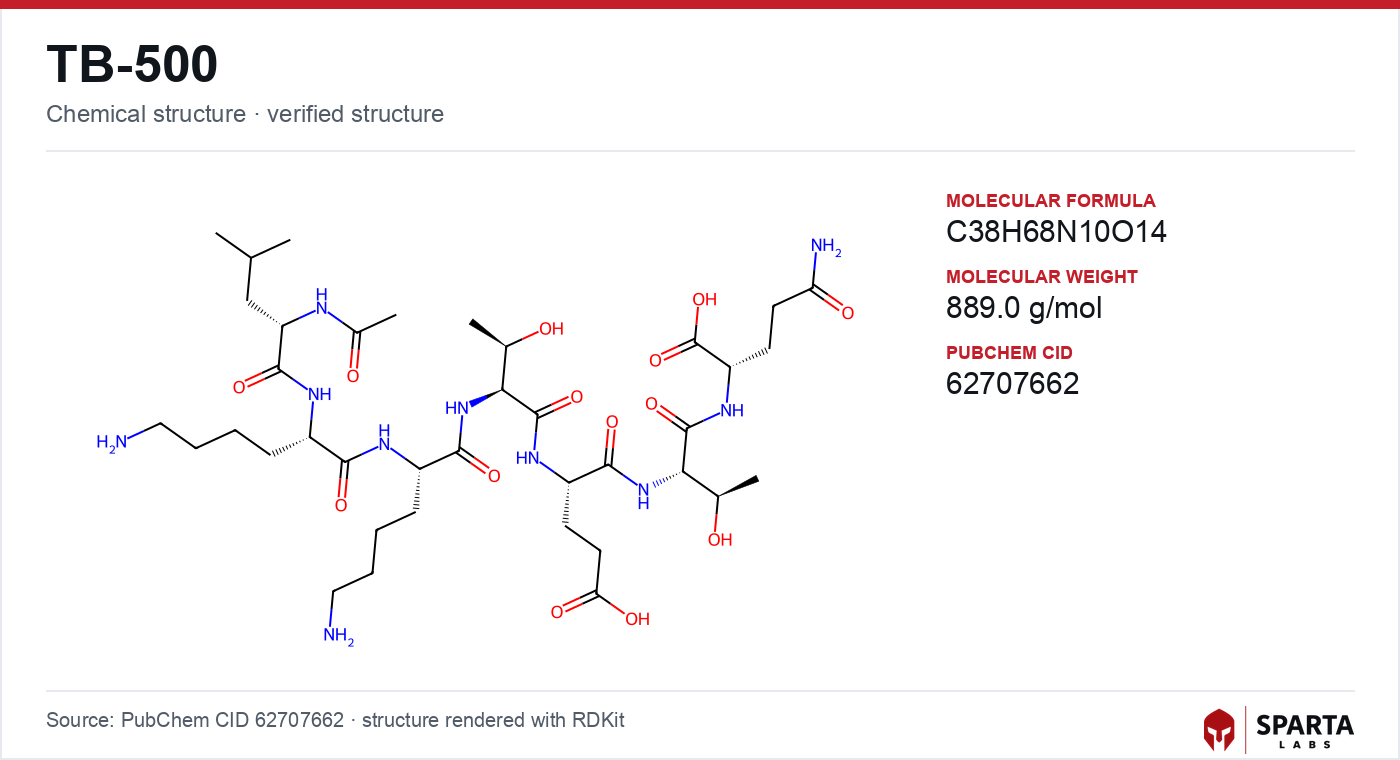
Figure: chemical structure of TB-500.
Why the Fragment Exists: The Actin-Sequestration Papers (1991–2004)
The scientific rationale for isolating the LKKTETQ region came from biochemistry, not clinical observation. Safer, Elzinga and Nachmias (1991), publishing in the Journal of Biological Chemistry, reported that thymosin beta-4 and the previously described actin-sequestering factor "Fx" were the same molecule, and that it bound monomeric G-actin in an approximately 1:1 stoichiometry that inhibited polymerization under the assay conditions used [1].
Findings from research models do not establish safety or efficacy in humans. Sparta Labs makes no claims about the use of this compound.
Two years later, Hannappel and Wartenberg (1993) mapped which parts of the peptide carried this activity. Using the DNase I inhibition assay, they reported that truncation variants retaining the central LKKTETQ motif preserved substantial actin-sequestering activity, whereas variants lacking that region showed markedly reduced activity [2]. This fragment-mapping result is the direct scientific origin of TB-500 as an object of study: it identified LKKTETQ as a minimal unit capable of engaging actin.
The structural basis was later resolved by Irobi and colleagues (2004) in the EMBO Journal, who used X-ray crystallography of a thymosin-beta-4–actin complex to place the peptide across the barbed- and pointed-end faces of the actin monomer, characterizing it as a member of the WH2 (WASP-homology 2) structural family [3]. Together these three papers explain why an eight-residue acetylated fragment became a research reagent at all, and they remain the load-bearing biochemistry for any downstream interpretation.
The Corneal and Epithelial Literature (2002–2022)
The most developed translational line for this peptide class is ophthalmic, and it uses the full-length protein. Sosne and colleagues (2002), in Experimental Eye Research, reported that topical thymosin beta-4 was associated with faster epithelial closure than vehicle in a rodent corneal-injury model, and the authors reasoned from prior in vitro data that the LKKTETQ subregion was the mechanistically relevant portion [4].
That preclinical line advanced into human trials of the ophthalmic formulation designated RGN-259. Sosne, Dunn and Kim (2015) reported a small randomized, double-masked, placebo-controlled Phase 2 study in severe dry eye in Cornea, describing differences on composite dry-eye endpoints while explicitly flagging the limited sample size as a constraint to be addressed [5].
A subsequent randomized, placebo-controlled, double-masked Phase 3 trial in neurotrophic keratopathy was reported by Bonini and colleagues (2022) in Clinical Ophthalmology, describing complete healing of persistent epithelial defects in a larger fraction of treated than placebo subjects at four weeks, with no serious adverse events attributed to the study compound [6]. Researchers should note the recurring caveat across this line: the evidence attaches to the full 43-residue peptide, not to the isolated Ac-LKKTETQ fragment.
The Cardiac and Developmental Literature (2007)
A separate and heavily cited strand concerns cardiovascular development. Smart and colleagues (2007), in Nature, reported that thymosin beta-4 was required for coronary vessel formation in the developing mouse heart and that the full-length protein mobilized adult epicardial cells and promoted their differentiation in explant preparations [7]. This paper is frequently the anchor citation for the peptide class in cardiac contexts, and it is again a full-protein result in a developmental and injury-model setting rather than a fragment study.
The gap between striking preclinical cardiac findings and later clinical outcomes is itself part of the record: an injectable full-length formulation (RGN-352) advanced into a Phase 2 acute-myocardial-infarction study (NCT01311518) sponsored by RegeneRx Biopharmaceuticals, which did not reproduce the functional improvements seen preclinically. That non-replication is a useful calibration point when reading enthusiastic early-phase animal data.
The Analytical-Chemistry and Anti-Doping Literature (2012–2022)
The fourth strand is where the fragment itself, rather than the parent protein, is studied directly, because anti-doping science needed a reference standard for the exact compound circulating as "TB-500." Esposito, Deventer, Goeman, Van der Eycken and Van Eenoo (2012), in Drug Testing and Analysis, reported the synthesis and structural characterization of the N-terminally acetylated fragment identified in TB-500 preparations, confirming the molecular identity against the predicted sequence [8]. This is one of the few peer-reviewed papers that speaks to what the fragment actually is as a chemical entity.
Ho and colleagues (2012) then reported validated liquid-chromatography–mass-spectrometry methods for detecting Ac-LKKTETQ and metabolites in equine urine and plasma at sub-nanogram-per-milliliter sensitivity [9]. A later review by Reichel (2022) in Antioxidants surveyed the analytical landscape for synthetic peptides in doping control, including thymosin-beta-4-derived sequences, and situated the fragment within metabolite-profiling programs [10]. For laboratories concerned with identity confirmation and analytical specifications, this strand is the most directly relevant, and it connects to the practical questions covered in the TB-500 sourcing and quality article.
Reading the Literature: Fragment Versus Parent
The single most important interpretive point across all four strands is that the clinical and in-vivo efficacy signals reside with full-length thymosin beta-4, while the direct fragment characterization is largely biochemical (actin binding) and analytical (identity and detection). Whether the isolated Ac-LKKTETQ fragment reproduces the tissue-level behaviors of the parent protein in complex biological systems is an open question that the published record does not resolve.
This is a familiar pattern in minimal-peptide research: a short motif is shown to carry a specific molecular activity, and its behavior in whole systems is then studied separately. The KPV published research article documents an analogous case, where a tripeptide fragment of alpha-MSH has been investigated to disentangle the activities of a larger parent molecule.
Knowledge Gaps
Several parameters remain incompletely characterized in the peer-reviewed literature for the isolated fragment specifically. Pharmacokinetic descriptors such as half-life, tissue distribution and metabolic fate for Ac-LKKTETQ as a standalone entity are not well established outside the analytical detection work.
The relative contribution of individual helical regions of the parent protein to complex processes is still an active structural question. And the fragment-versus-parent equivalence discussed above is, at present, an assumption inherited from biochemistry rather than a demonstrated result in vivo. Researchers evaluating reference material for preclinical work can review the identity and analytical specifications for TB-500 from Sparta Labs.
References
-
Safer D, Elzinga M, Nachmias VT. Thymosin beta 4 and Fx, an actin-sequestering peptide, are indistinguishable. J Biol Chem. 1991;266(7):4029–4032. PMID: 1999398. View on PubMed
-
Hannappel E, Wartenberg F. Actin-sequestering ability of thymosin beta 4, thymosin beta 4 fragments, and thymosin beta 4-like peptides as assessed by the DNase I inhibition assay. Biol Chem Hoppe Seyler. 1993;374(2):117–122. PMID: 8471179. View on PubMed
-
Irobi E, Aguda AH, Larsson M, et al. Structural basis of actin sequestration by thymosin-beta4: implications for WH2 proteins. EMBO J. 2004;23(18):3599–3608. PMC517612. Full text on PMC
-
Sosne G, Szliter EA, Barrett R, Kleinman HK, Bhattacharya B. Thymosin beta 4 promotes corneal wound healing and decreases inflammation in vivo following alkali injury. Exp Eye Res. 2002;74(2):293–299. PMID: 11950239. View on PubMed
-
Sosne G, Dunn SP, Kim C. Thymosin beta4 significantly improves signs and symptoms of severe dry eye in a phase 2 randomized trial. Cornea. 2015;34(5):491–496. PMID: 25826322. View on PubMed
-
Bonini S, Sheha H, Hamrah P, et al. 0.1% RGN-259 (thymosin beta4) ophthalmic solution promotes healing and improves comfort in neurotrophic keratopathy patients in a randomized, placebo-controlled, double-masked Phase III clinical trial. Clin Ophthalmol. 2022;16:4295–4310. PMC9820614. Full text on PMC
-
Smart N, Risebro CA, Melville AA, et al. Thymosin beta4 induces adult epicardial progenitor mobilization and neovascularization. Nature. 2007;445(7124):177–182. PMID: 17108969. View on PubMed
-
Esposito S, Deventer K, Goeman J, Van der Eycken J, Van Eenoo P. Synthesis and characterization of the N-terminal acetylated 17-23 fragment of thymosin beta 4 identified in TB-500, a product suspected to possess doping potential. Drug Test Anal. 2012;4(9):733–738. PMID: 22962027. View on PubMed
-
Ho EN, Kwok WH, Lau MY, Wong AS, Wan TS, Lam KK, et al. Doping control analysis of TB-500, a synthetic version of an active region of thymosin beta4, in equine urine and plasma by liquid chromatography-mass spectrometry. J Chromatogr A. 2012;1265:57–69. PMID: 23084823. View on PubMed
-
Reichel C. Synthetic peptides in doping control: a powerful tool for an analytical challenge. Antioxidants (Basel). 2022;11(10):1922. PMC9631397. Full text on PMC
Disclaimer. Statements in this article have not been evaluated by the Food and Drug Administration. This compound is not intended to diagnose, treat, cure, or prevent any disease. Sparta Labs sells research-use-only materials. Content is provided for educational and informational purposes only and does not constitute medical advice. Consult a qualified medical professional for any health concerns.
Frequently asked questions
Is TB-500 the same as thymosin beta-4?
No. TB-500 is a synthetic, N-terminally acetylated peptide corresponding to the actin-binding region of thymosin beta-4, a 43-residue protein. The fragment centers on the LKKTETQ sequence identified by Safer and Chowrashi in 1993 as carrying much of the parent protein's actin-sequestering activity. Most published in-vivo and clinical studies used the full-length protein rather than the isolated fragment.
What did the foundational biochemistry papers on this peptide report?
Safer, Elzinga and Nachmias reported in 1991 that thymosin beta-4 bound monomeric actin roughly 1:1 and inhibited polymerization under assay conditions. Safer and Chowrashi then mapped the LKKTETQ motif as the region responsible for much of that activity in 1993. Irobi and colleagues resolved the structural basis by X-ray crystallography in 2004, classifying the peptide within the WH2 family.
What clinical trials have been reported for the thymosin beta-4 formulation RGN-259?
A small randomized, double-masked, placebo-controlled Phase 2 study in severe dry eye was reported by Sosne, Dunn and Kim in Cornea in 2015. A Phase 3 trial in neurotrophic keratopathy was reported by Bonini and colleagues in Clinical Ophthalmology in 2022. Both used the full-length ophthalmic formulation, not the isolated Ac-LKKTETQ fragment; findings in research settings do not establish efficacy in humans generally.
Why does anti-doping research study TB-500 directly?
Anti-doping laboratories required a reference standard for the exact compound circulating as TB-500. Görgens and colleagues characterized the acetylated fragment's structure in 2012, and Weidemann and colleagues reported validated mass-spectrometry detection methods in equine samples in 2013. This analytical strand is one of the few peer-reviewed lines that examines the isolated fragment rather than the parent protein.