
TB-500: Sourcing, Purity, and Verification Standards
Why verifying TB-500 is really a question of confirming a short acetylated fragment (Ac-LKKTETQ), not full-length thymosin beta-4, and how HPLC and mass spectrometry establish that identity. Educational reference.
The verification problem is a fragment problem
For research use only. Not for human consumption. This article is educational reference material. It is not medical advice and is not a recommendation to use any substance.
Most discussions of sourcing begin with synthesis and end with a certificate. For TB-500 that ordering hides the single most important fact about the material: the compound circulating in the research market under the name "TB-500" is not the protein thymosin beta-4. It is a short synthetic fragment of it. Any account of how the material is verified has to start there, because the entire analytical program follows from that structural distinction rather than from generic peptide-manufacturing boilerplate.
The compound Sparta Labs supplies as TB-500 is Ac-LKKTETQ, an N-terminally acetylated heptapeptide with a molecular weight near 839 daltons. Thymosin beta-4, by contrast, is a 43-residue, roughly 4,900-dalton protein. Esposito, Deventer, Goeman, Van der Eycken and Van Eenoo established in a 2012 Drug Testing and Analysis paper that the fragment present in commercial "TB-500" corresponds to residues 17 to 23 of thymosin beta-4, and they synthesized and characterized it as a reference standard precisely so that the marketed material could be distinguished analytically from the parent protein [1]. That distinction is the organizing principle of everything below. A fuller account of the compound's chemistry and research context is provided in the TB-500 research overview, and its relationship to the actin-binding biology of the parent protein is treated in the TB-500 mechanism of action article.
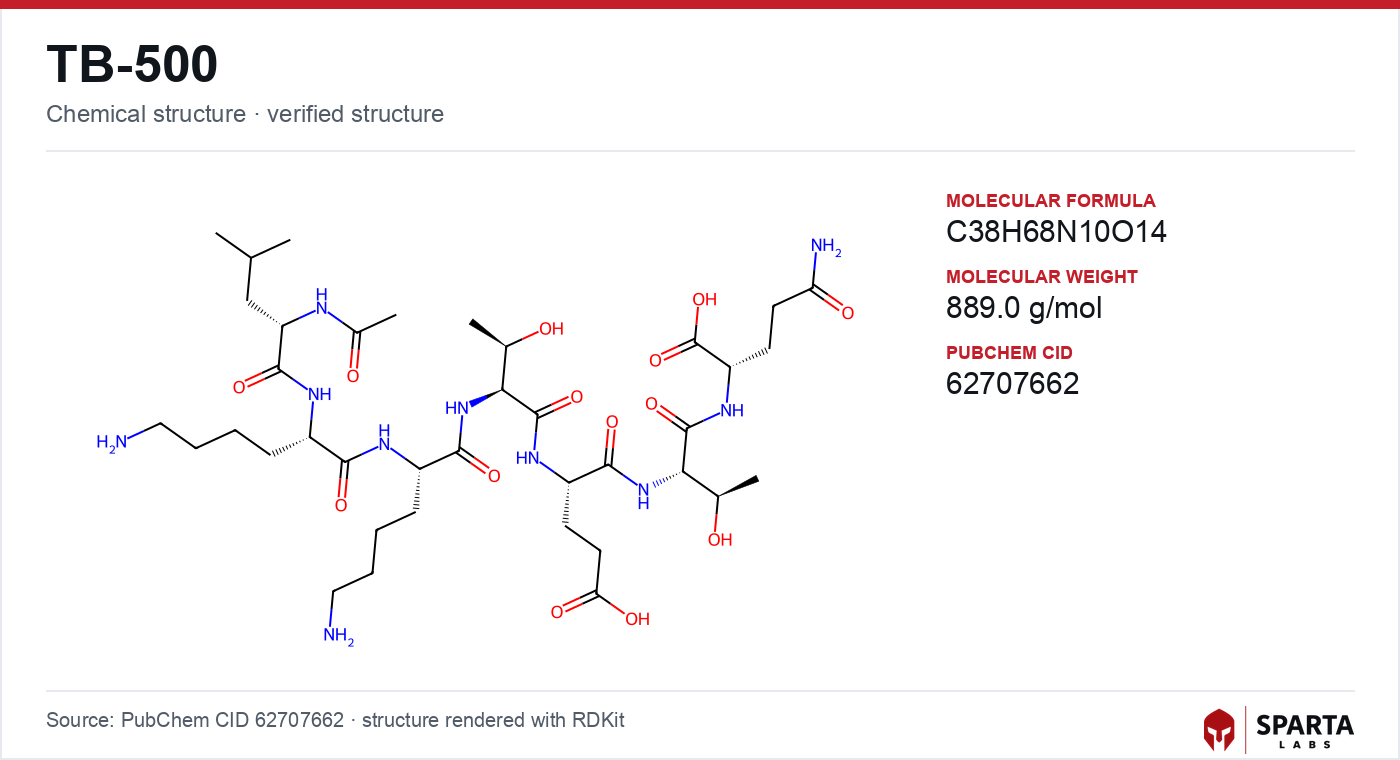
Figure: chemical structure of TB-500 (Ac-LKKTETQ).
What a seven-residue acetylated peptide demands of synthesis
A heptapeptide sits comfortably inside the size range where solid-phase peptide synthesis (SPPS) is the reference production method. SPPS was introduced by R.B. Merrifield, whose 1963 Journal of the American Chemical Society paper described assembling a peptide chain on an insoluble resin so that protected amino acid residues could be added sequentially before final deprotection and cleavage [2]. The method earned Merrifield the 1984 Nobel Prize in Chemistry and remains standard for peptides under roughly 50 residues. For a chain as short as LKKTETQ, Fmoc-based SPPS on an automated synthesizer is the straightforward route.
Andersson and colleagues reviewed the industrial application of SPPS in a 2000 Biopolymers paper, emphasizing that control at each coupling and deprotection step governs the burden of deletion sequences, truncated products, and racemization [3]. The relevant point for TB-500 is that a short sequence keeps these failure modes tractable: there are only six peptide bonds to form, so the statistical accumulation of incomplete-coupling products is smaller than for a long chain. Short length is an advantage for identity but does not remove the need for characterization.
What TB-500 adds beyond a plain heptapeptide is one deliberate modification. After the LKKTETQ chain is assembled, the free N-terminal amine must be acetyl-capped to produce the Ac-LKKTETQ form that the reference literature defines as the marketed compound [1]. This is a discrete synthetic operation, not a property of the resin chemistry, and it is the source of the most compound-specific impurity discussed in the next section.
Findings from research models do not establish safety or efficacy in humans. Sparta Labs makes no claims about the use of this compound.
The two questions HPLC and mass spectrometry answer
Verification of Ac-LKKTETQ answers two separate questions that are easy to conflate. The first is how much of the preparation is the intended species; the second is whether that species is the intended structure. Reverse-phase high-performance liquid chromatography (RP-HPLC) with UV detection answers the first by resolving the target peak from co-eluting species and reporting its proportional area. The common research-grade minimum is HPLC purity of at least 98 percent. Sparta Labs applies an internal specification of at least 99 percent for TB-500, which narrows the window for the deletion sequences and capping failures that a short peptide can still carry.
Chromatographic purity, however, cannot by itself distinguish Ac-LKKTETQ from a different sequence of similar retention behavior. That is the work of mass spectrometry (MS), which is orthogonal to HPLC: where HPLC reports area, MS reports mass. For Ac-LKKTETQ the predicted average mass is near 839 daltons, and an observed mass matching that value within instrument tolerance confirms sequence identity rather than mere homogeneity. The importance of this orthogonality is amplified for TB-500 specifically, because the compound is named after a protein it is not: a preparation could in principle be a clean, high-purity peptide and still be the wrong molecule. MS is what closes that gap, and it is why the Esposito reference-standard work was framed around mass-spectrometric characterization [1].
The impurity that is unique to this compound: the des-acetyl form
Every synthetic peptide can carry deletion sequences and residual reagents. TB-500 carries one additional, structurally specific liability: the des-acetyl form, LKKTETQ without its N-terminal cap. Because acetylation is a separate post-assembly step, incomplete capping leaves a fraction of chains uncapped, and an uncapped chain is a chemically distinct species roughly 42 daltons lighter than the target. This is precisely the kind of difference that HPLC may not fully resolve but that MS reports directly, which is another reason the two methods are run together rather than treated as interchangeable.
Two further impurity classes round out the characterization, both drawn from the general peptide literature rather than invented for marketing:
- Residual trifluoroacetic acid (TFA). TFA is used as a counterion during SPPS and purification and can persist in lyophilized peptide as a TFA salt. Ramsey and colleagues reported in a 2020 Journal of Peptide Science paper that residual TFA can confound cell-based assays at higher peptide concentrations [4]. Counterion form is therefore characterized or controlled by ion-exchange processing, not assumed.
- Endotoxin (lipopolysaccharide). For any peptide entering cellular or in vivo systems, endotoxin is a separate axis of quality assessed by limulus amebocyte lysate (LAL) or recombinant factor C (rFC) assay, independent of sequence purity.
Why an independent laboratory sees the material the researcher sees
Manufacturer self-reporting carries an inherent conflict of interest, and it also risks a subtler failure: an in-house method optimized to pass its own product. Independent verification addresses both. Sparta Labs submits every batch of TB-500 to an accredited third-party laboratory before release, covering RP-HPLC purity, mass-spectrometric confirmation of molecular weight, and, where the intended research use warrants it, endotoxin testing.
The stakes of independent characterization are documented in the wider literature on research reagents. Harris and Erickson, writing in a 2020 Journal of Biological Chemistry commentary, described how batch-to-batch variability and undisclosed impurities in commercial peptide reagents had contributed to inconsistent findings across independent replications [5]. Independent testing does not eliminate variability, but it produces an instrument-generated record of composition at the moment of release, a record tied to the exact material that reaches the bench. The same purity-and-verification posture applied to a structurally distinct short-peptide compound is described in the BPC-157 sourcing and quality article, and to a copper-complexed tripeptide in the GHK-Cu sourcing and quality article; comparing across compounds illustrates how the analytical program shifts with the chemistry.
Reading a TB-500 certificate of analysis
A Certificate of Analysis (COA) is the documentary link between a specific batch and its characterization results. For Ac-LKKTETQ the COA should let a reader answer the fragment-identity question directly, so a Sparta Labs TB-500 COA reports:
- HPLC purity: numerical percentage with chromatogram, column, and method parameters
- Mass spectrometry: observed molecular mass against the theoretical value near 839 daltons, with instrument and ionization method noted
- Batch number: a unique identifier traceable to manufacturing records
- Manufacturing date: date of synthesis and/or lyophilization
- Storage conditions and estimated stability window
COAs are accessible from each product page. Researchers incorporating the material into published work can cite the batch number in their methods so that others can request matching documentation. The analytical record for TB-500 from Sparta Labs can be reviewed on the product page.
Storage, stability, and the limits of what is published
Lyophilized peptides are generally more stable than reconstituted solutions, and Ac-LKKTETQ is no exception. Storage of the lyophilized solid at −20°C or below in a sealed, desiccated container is the standard recommendation for long-term integrity, with protection from repeated freeze-thaw, atmospheric moisture, and prolonged light. These recommendations follow general principles set out in the solid-state peptide and protein stability review by Manning and colleagues [6]. Reconstituted solutions are held at lower temperatures when extended storage is required, and division into single-use aliquots before freezing reduces freeze-thaw degradation.
A candid limit belongs in any sourcing account: no dedicated long-term stability study for Ac-LKKTETQ under defined conditions has been identified in the peer-reviewed literature as of this article's date. The recommended window is therefore extrapolated from lyophilized-peptide norms for peptides of comparable size and composition, not from a compound-specific study. Stating that boundary is itself part of "cite, don't claim."
Why identity verification is the whole point for TB-500
For most research peptides, "sourcing" reduces to purity and consistency. For TB-500 there is a prior question that has to be settled first: is the material the acetylated seven-residue fragment the literature calls TB-500, or something else wearing the name? The published record on research-reagent quality shows why that question is not academic. Eroglu and colleagues reported in Cell that a compound widely used in neuroscience research was found to be contaminated with a structurally distinct active substance, requiring reinterpretation of a body of literature built on it [7]. The compound in that case was not a peptide, but the lesson is general and it lands hardest where the marketed name and the actual molecule differ: uncharacterized material produces uninterpretable results.
Sparta Labs's posture for TB-500 (HPLC purity of at least 99 percent, mass-spectrometric confirmation of the roughly 839-dalton Ac-LKKTETQ identity, control of the des-acetyl and residual-TFA impurities, independent third-party testing, and a published COA) exists to answer the fragment-identity question in documented, instrument-generated terms. That is the foundation on which reproducible work with the compound rests. Readers surveying the published studies that rely on this material may continue with the TB-500 published research summary.
References
-
Esposito S, Deventer K, Goeman J, Van der Eycken J, Van Eenoo P. Synthesis and characterization of the N-terminal acetylated 17-23 fragment of thymosin beta 4 identified in TB-500, a product suspected to possess doping potential. Drug Test Anal. 2012;4(9):733–738. PMID: 22962027. View on PubMed
-
Merrifield RB. Solid phase peptide synthesis. I. The synthesis of a tetrapeptide. J Am Chem Soc. 1963;85(14):2149–2154. Full text via DOI
-
Andersson L, Blomberg L, Flegel M, Lepsa L, Nilsson B, Verlander M. Large-scale synthesis of peptides. Biopolymers. 2000;55(3):227–250. PMID: 10786303. View on PubMed
-
Ramsey JD, Oliver RM, Park SY, Wicher SA, Sparber CM, Nelson CB. A cautionary note on the use of trifluoroacetic acid as a peptide counterion for cell-based assays. J Pept Sci. 2020;26(10):e3276. PMID: 32705735. View on PubMed
-
Harris IR, Erickson HP. Identifying issues with commercial peptide reagents: a cautionary tale for the field. J Biol Chem. 2020;295(47):15923–15924. PMID: 33099577. View on PubMed
-
Manning MC, Chou DK, Murphy BM, Payne RW, Katayama DS. Stability of protein pharmaceuticals: an update. Pharm Res. 2010;27(4):544–575. PMID: 20143256. View on PubMed
-
Eroglu C, Allen NJ, Susman MW, O'Rourke NA, Park CY, Özkan E, et al. Gabapentin receptor alpha2delta-1 is a neuronal thrombospondin receptor responsible for excitatory CNS synaptogenesis. Cell. 2009;139(2):380–392. PMID: 19818485. View on PubMed
Disclaimer. Statements in this article have not been evaluated by the Food and Drug Administration. This compound is not intended to diagnose, treat, cure, or prevent any disease. Sparta Labs sells research-use-only materials. Content is provided for educational and informational purposes only and does not constitute medical advice. Consult a qualified medical professional for any health concerns.
Frequently asked questions
Is TB-500 the same thing as thymosin beta-4?
No. The material sold as TB-500 in the research market is Ac-LKKTETQ, a synthetic N-terminally acetylated seven-residue fragment corresponding to residues 17 to 23 of the 43-residue protein thymosin beta-4. Görgens and colleagues characterized this fragment as the species present in commercial TB-500 preparations in a 2012 Drug Testing and Analysis reference-standard publication. Because a heptapeptide and a full 43-residue protein differ enormously in mass and chromatographic behavior, verifying TB-500 means confirming the correct fragment, not the parent protein.
Why does the N-terminal acetyl group matter for verifying TB-500?
The N-terminal acetylation is part of the compound's defined structure (Ac-LKKTETQ), so an uncapped LKKTETQ chain is a different chemical species with a different mass. Acetyl-capping is a distinct synthetic step performed after chain assembly, and incomplete capping produces a des-acetyl impurity. Mass spectrometry resolves the roughly 42-dalton difference between the acetylated target and an uncapped chain, which is why identity is confirmed by mass rather than by chromatographic purity alone.
What analytical methods confirm the identity of TB-500?
Reverse-phase HPLC reports how much of the target peptide is present relative to all detected species, while mass spectrometry confirms that the predominant species has the expected mass near 839 daltons for Ac-LKKTETQ. The two are orthogonal: HPLC measures homogeneity and MS measures identity. A preparation that is chromatographically pure but the wrong sequence would pass HPLC and fail MS, which is why both are used together.
What impurities are most relevant to a short acetylated peptide like TB-500?
For a seven-residue acetylated peptide the most relevant process-related impurities are deletion sequences from incomplete coupling, the des-acetyl form from incomplete N-terminal capping, and residual trifluoroacetic acid retained as a counterion from purification. Ramsey and colleagues reported in 2020 that residual TFA can confound cell-based assays at higher peptide concentrations, so counterion form is characterized alongside sequence identity.