
Sermorelin: Published Research
A bibliographic summary of published research on sermorelin (GRF 1-29): diagnostic stimulation testing, pediatric growth-hormone-deficiency trials, GH-axis pharmacodynamics, and studies in older adults. Educational reference.
For research use only. Not for human consumption. This article is educational reference material. It is not medical advice and is not a recommendation to use any substance.
Introduction
Sermorelin, also referred to in the literature as GRF 1-29 or sermorelin acetate, is a synthetic peptide corresponding to the first 29 amino acids of endogenous human growth-hormone-releasing hormone (GHRH). It is the shortest fragment of GHRH that retains the full intrinsic activity of the parent molecule at the pituitary GHRH receptor, which made it a widely used research and diagnostic tool for probing the growth-hormone (GH) axis.
The published research record on sermorelin is concentrated in three areas: its use as a provocative diagnostic agent for assessing pituitary somatotroph reserve, controlled investigation in children with growth failure attributed to idiopathic GH deficiency, and pharmacodynamic studies of GH and insulin-like growth factor 1 (IGF-1) responses in older adults.
This article provides an annotated bibliographic summary of key published studies, organized by methodology type, with attribution and citation for each reported finding. Foundational receptor pharmacology is discussed separately in the sermorelin mechanism of action article.
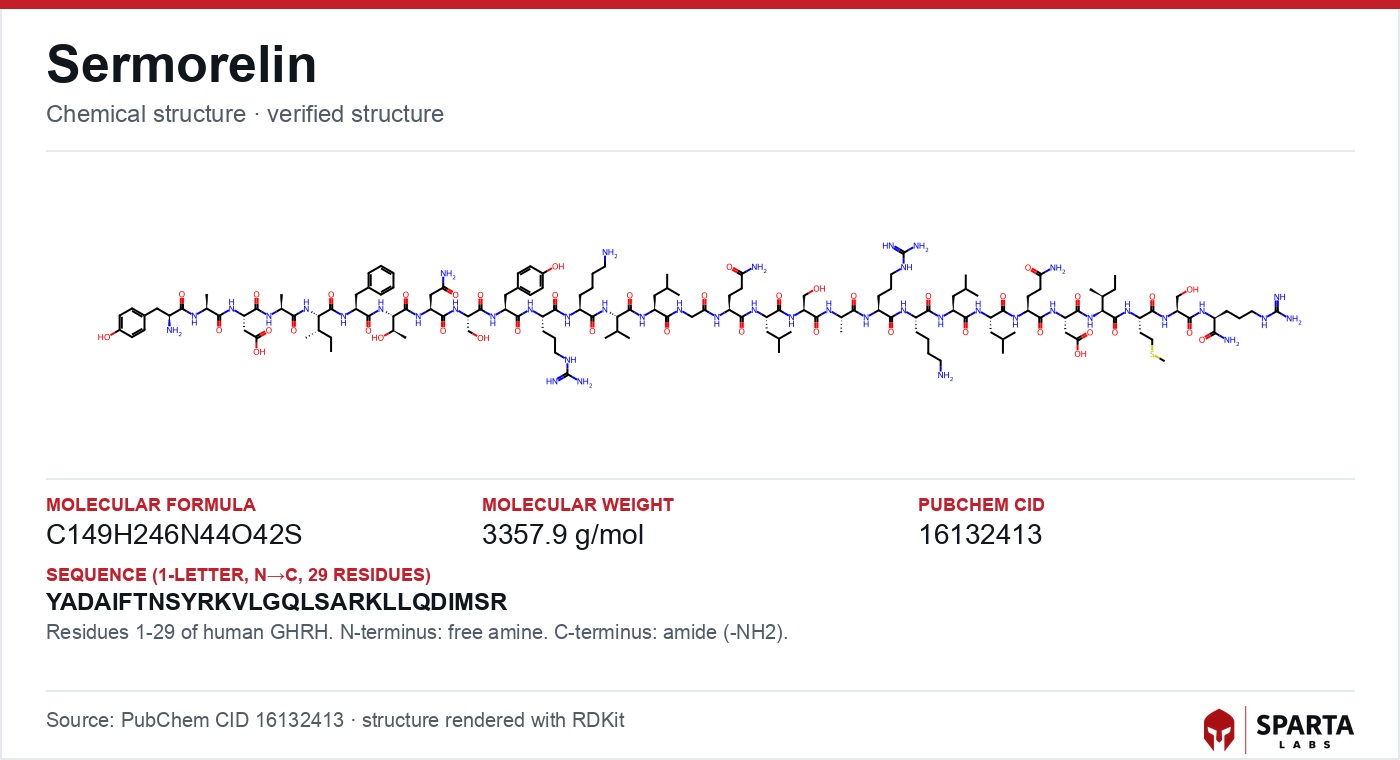
Figure: chemical structure of sermorelin.
Methodology Types in the Published Literature
The sermorelin research literature encompasses several distinct study designs. Provocative diagnostic-testing studies administered a single dose and measured the subsequent GH response to characterize pituitary somatotroph reserve, frequently comparing GRF(1-29)NH2 against longer GRF fragments. Controlled and open-label pediatric studies examined growth outcomes in children with idiopathic GH deficiency over extended treatment intervals; much of this evidence was synthesized in a review article rather than a single pivotal trial.
Short-duration pharmacodynamic studies in older adults measured integrated GH secretion, GH pulse characteristics, and IGF-1 concentrations, sometimes with secondary body-composition endpoints. As permitted for reporting published clinical-trial methodology, the dose, route, and duration used by each cited study are stated below strictly as description of what the trial did, not as guidance.
Summary of Published Studies
Ranke et al., 1986 (European Journal of Pediatrics)
Ranke and colleagues (1986) reported a diagnostic-testing study in which GRF(1-29)NH2 was compared against the longer GRF(1-40) fragment in 11 young adult volunteers, and was then used to test 131 children and adolescents, 45 of whom had idiopathic GH deficiency.
The authors reported that the two fragments produced comparable GH responses in the adult comparison, and that the maximal GH level observed during a 120-minute test period was suitable for characterizing responsiveness. A maximal GH level above a defined threshold was described as characteristic of a normal response in the published protocol [1].
Findings from research models do not establish safety or efficacy in humans. Sparta Labs makes no claims about the use of this compound.
Prakash and Goa, 1999 (BioDrugs)
Prakash and Goa (1999) published a review of the use of sermorelin in the diagnosis and treatment of children with idiopathic GH deficiency. The authors summarized diagnostic-testing data in which a single intravenous dose administered in conjunction with conventional testing was reported to be suitable as a provocative test of GH secretion, and treatment data in which once-daily subcutaneous administration over an extended interval was reported to be associated with growth responses in some prepubertal children.
The review also discussed the compound's short plasma half-life, reported at approximately 10 to 20 minutes in humans, and the tolerability profile described across the studies reviewed [2]. As a synthesized review rather than a single trial, this reference aggregates multiple primary sources and remains a central bibliographic entry point to the pediatric literature.
Corpas et al., 1992 (Journal of Clinical Endocrinology and Metabolism)
Corpas and colleagues (1992) examined GH and IGF-1 responses in healthy older men. In the published protocol, GRF(1-29) was administered subcutaneously twice daily over a two-week interval in a placebo-controlled design. The authors reported that the treatment interval was associated with increases in GH pulse amplitude and integrated GH concentration toward reference values observed in younger adults, with parallel increases in IGF-1 concentrations [3]. This study is frequently cited as early controlled evidence characterizing GH-axis responsiveness to GHRH-fragment administration in an aging population.
Vittone et al., 1997 (Metabolism)
Vittone and colleagues (1997) reported a study in healthy elderly men who received nightly subcutaneous GRF(1-29) over a six-week interval. The authors reported increases in IGF-1, IGF-binding protein 3, and GH-binding proteins relative to baseline, alongside a measured change in lean body mass. The study characterized the endocrine response to nightly administration and contributed pharmacodynamic data on the GH axis in older men [4].
Khorram et al., 1997 (Journal of Clinical Endocrinology and Metabolism)
Khorram and colleagues (1997) reported the endocrine and metabolic effects of longer-term administration of a stabilized GHRH-(1-29)-NH2 analog ([Nle27]) in age-advanced men and women. In the published design, the analog was administered over an extended interval, and the authors reported changes in GH and IGF-1 concentrations together with secondary metabolic and body-composition measures. The study extended the pharmacodynamic characterization of GHRH-fragment administration to both sexes in an older population [5].
Regulatory-record studies
Sermorelin acetate was marketed under the brand name Geref. Public regulatory records document that the diagnostic formulation received initial US approval in 1990 for evaluating the ability of the pituitary somatotroph to secrete GH, and a treatment formulation received initial approval in 1997 for idiopathic GH deficiency in children with growth failure, with the product subsequently withdrawn from sale.
A US Federal Register determination later stated that these formulations were not withdrawn for reasons of safety or effectiveness [6]. This regulatory history is relevant to interpreting the age and reporting standards of the primary trial literature; further detail appears in the sermorelin history article.
Knowledge Gaps
Several areas in the sermorelin research literature represent active or unresolved directions.
The compound's short plasma half-life, reported at roughly 10 to 20 minutes and attributed in the literature to renal filtration and enzymatic degradation, has motivated research into stabilized analogs and delivery approaches such as PEGylation. The comparative pharmacology of GHRH fragments and receptor agonists is discussed alongside related growth-hormone secretagogues; the published record on tesamorelin, a stabilized GHRH analog, provides complementary data on longer-acting molecules in the same pharmacological class. A structured comparison of the two GHRH analogs is available in the tesamorelin vs sermorelin article.
The generalizability of GH-axis findings across age groups remains a subject of investigation, as the primary evidence base is distributed unevenly across pediatric and older-adult populations with differing endpoints. Much of the pediatric evidence predates contemporary randomized-trial reporting standards, a limitation noted in synthesized reviews of the literature.
Mechanistic questions regarding the interaction between GHRH-fragment signaling and endogenous somatostatin feedback continue to be examined; the ghrelin-receptor secretagogues represent a distinct pharmacological pathway, and the published research on compounds such as GHRP-2 offers a comparative reference point for GH-axis modulation across mechanisms. Research-grade sermorelin from Sparta Labs is provided as a research-use-only material with independent third-party analytical testing.
References
-
Ranke MB, Gruhler M, Rosskamp R, Brügmann G, Attanasio A, Blum WF, Bierich JR. Testing with growth hormone-releasing factor (GRF(1-29)NH2) and somatomedin C measurements for the evaluation of growth hormone deficiency. Eur J Pediatr. 1986;145(6):485-92. PMID: 2880720. DOI: 10.1007/BF02429050
-
Prakash A, Goa KL. Sermorelin: a review of its use in the diagnosis and treatment of children with idiopathic growth hormone deficiency. BioDrugs. 1999;12(2):139-57. PMID: 18031173. DOI: 10.2165/00063030-199912020-00007
-
Corpas E, Harman SM, Piñeyro MA, Roberson R, Blackman MR. Growth hormone (GH)-releasing hormone-(1-29) twice daily reverses the decreased GH and insulin-like growth factor-I levels in old men. J Clin Endocrinol Metab. 1992;75(2):530-5. PMID: 1379256. DOI: 10.1210/jcem.75.2.1379256
-
Vittone J, Blackman MR, Busby-Whitehead J, Tsiao C, Stewart KJ, Tobin J, et al. Effects of single nightly injections of growth hormone-releasing hormone (GHRH 1-29) in healthy elderly men. Metabolism. 1997;46(1):89-96. PMID: 9005976. DOI: 10.1016/S0026-0495(97)90174-8
-
Khorram O, Laughlin GA, Yen SSC. Endocrine and metabolic effects of long-term administration of [Nle27]growth hormone-releasing hormone-(1-29)-NH2 in age-advanced men and women. J Clin Endocrinol Metab. 1997;82(5):1472-9. PMID: 9141535. DOI: 10.1210/jcem.82.5.3943
-
US Food and Drug Administration. Determination That GEREF (Sermorelin Acetate) Injection Formulations Were Not Withdrawn From Sale for Reasons of Safety or Effectiveness. Federal Register. 2013 Mar 4;78(42):14002. Available at: Source: federalregister.gov
Disclaimer. Statements in this article have not been evaluated by the Food and Drug Administration. This compound is not intended to diagnose, treat, cure, or prevent any disease. Sparta Labs sells research-use-only materials. Content is provided for educational and informational purposes only and does not constitute medical advice. Consult a qualified medical professional for any health concerns.
Frequently asked questions
What research has been done on sermorelin?
The published sermorelin literature spans diagnostic stimulation-testing studies used to assess pituitary growth-hormone reserve, controlled trials in children with idiopathic growth hormone deficiency, and pharmacodynamic studies of GH and IGF-1 responses in older adults. A 1999 BioDrugs review by Prakash and Goa summarizes much of the diagnostic and pediatric evidence base.
What clinical trials exist for sermorelin?
Reported clinical investigation includes diagnostic testing studies such as Ranke and colleagues (1986), pediatric growth-failure trials summarized in the Prakash and Goa (1999) review, and controlled GH-axis studies in older adults by Corpas and colleagues (1992), Vittone and colleagues (1997), and Khorram and colleagues (1997). Sermorelin was also studied as a provocative diagnostic agent for pituitary somatotroph reserve.
What did the sermorelin stimulation-test research find?
Ranke and colleagues (1986) reported that intravenous GRF(1-29)NH2 produced growth hormone responses comparable to the longer GRF(1-40) fragment in young adult volunteers, and characterized peak GH levels across a pediatric cohort. The peak GH response was used in the published protocol as a threshold to characterize somatotroph responsiveness.
What are the knowledge gaps in sermorelin research?
Active questions in the literature include the compound's short plasma half-life and approaches such as PEGylation to extend it, the generalizability of GH-axis findings across age groups, and the durability of pharmacodynamic responses over longer intervals. Much of the pediatric evidence predates modern trial-reporting standards, which the Prakash and Goa review noted when assessing the strength of available data.