
Peptide Therapy vs Research Peptides: A Regulatory Classification Explainer
Peptide therapy refers to clinician-administered use of FDA-approved or lawfully compounded peptide drugs. Research-use-only peptides are laboratory materials that fall outside that framework entirely. This explainer sets out the legal categories and their history.
Introduction
"Peptide therapy" and "research peptides" are frequently used side by side, and the pairing invites a misunderstanding that this article exists to correct. As a matter of regulation and classification, peptide therapy refers to the clinician-administered use of peptide drugs: products that have either been approved by the U.S. Food and Drug Administration or lawfully compounded for an individual patient under the compounding provisions of the Federal Food, Drug, and Cosmetic Act (FDCA). Research-use-only (RUO) peptides supplied by chemical suppliers, including Sparta Labs, are laboratory materials that sit outside that framework entirely. They are not peptide therapy, they are not for human use, and they are not an alternative to it. What follows explains the legal categories, how US law distinguishes them, how the peptide-drug field developed, and why the distinction is not a technicality. It makes no statement about the effects of any peptide in any setting. Background on the chemistry is available in the overview of what peptides are.
What the phrase "peptide therapy" refers to
In clinical usage, peptide therapy means the prescription and administration of a peptide drug by a licensed clinician for a patient under that clinician's care. The drug in question belongs to one of two regulated categories. It may be an FDA-approved product: examples that are matters of public regulatory record include insulin, teriparatide (approved as Forteo in 2002) [1], semaglutide (approved as Ozempic in 2017) [2], tesamorelin (approved as Egrifta in 2010) [3], bremelanotide (approved as Vyleesi in 2019) [4], and synthetic oxytocin (Pitocin) [5]. Or it may be a compounded drug prepared for that patient by a licensed pharmacist, physician, or registered outsourcing facility under sections 503A or 503B of the FDCA [6, 7].
Peptide therapy is therefore a category of medical practice defined by who administers the drug, under what authority, and through which regulatory pathway the drug reached the patient. It is not a category of molecule. This article names approved products only to identify what the phrase refers to; it does not describe or evaluate their use. The history of one of them, tesamorelin, is traced in the tesamorelin history article.
How US law defines a drug
The FDCA defines a drug, in relevant part, as an article "intended for use in the diagnosis, cure, mitigation, treatment, or prevention of disease in man or other animals" or "intended to affect the structure or any function of the body of man or other animals" [8]. The definition is built on intent rather than chemistry, and it is the reason a single peptide sequence can be a drug in one context and a laboratory reagent in another.
The FDA's regulation on the meaning of "intended uses," 21 CFR 201.128, describes how that intent is established. It refers to "the objective intent of the persons legally responsible for the labeling of an article," which "may be shown by such persons' expressions, the design or composition of the article, or by the circumstances surrounding the distribution of the article," including "labeling claims, advertising matter, or oral or written statements" [9]. Intent is judged from all the circumstances of marketing together. An RUO label describes a material's intended use; it does not override statements or circumstances that indicate a different one.
Three regulatory categories
Approved peptide drugs
An approved drug has passed FDA premarket review under a new drug application or biologics license application. The agency has evaluated the product's safety and effectiveness for a specified indication, its manufacturing under current good manufacturing practice, and its labeling, and the product is dispensed on prescription. Muttenthaler and colleagues, writing in Nature Reviews Drug Discovery in 2021, reported that more than 80 peptide drugs had reached the world market since insulin [10]. Lau and Dunn, in Bioorganic and Medicinal Chemistry in 2018, counted over 60 peptide drugs approved in the United States and other major markets and more than 150 in clinical development [11]. Wang and colleagues reviewed the current applications of therapeutic peptides in Signal Transduction and Targeted Therapy in 2022 [12]. These counts vary with the definition of "peptide" applied and the markets included, but they establish the scale of the approved category.
Compounded drugs
Compounding is the preparation of a drug for an individual patient whose needs, in the prescriber's judgment, are not met by an approved product. Section 503A of the FDCA permits compounding by "a licensed pharmacist in a State licensed pharmacy or a Federal facility, or a licensed physician" on "a valid prescription order" for an identified patient, and it imposes conditions on the bulk drug substances that may be used, including compliance with an applicable pharmacopeial monograph or presence on an FDA list, manufacture by a registered establishment, and accompanying certificates of analysis [6]. Section 503B, added in 2013, created registered outsourcing facilities that compound under FDA inspection and current good manufacturing practice, using bulk substances that appear on an FDA list of substances for which there is a clinical need or that are on the drug shortage list [7].
The FDA states that "compounded drugs are not FDA-approved," which means the agency "does not verify the safety, effectiveness or quality of compounded drugs before they are marketed" [13]. Compounding is nonetheless a regulated activity practiced under license and on prescription, and it belongs on the "peptide therapy" side of the line.
The FDA has also acted on specific peptides within the compounding framework. Its page on bulk drug substances that may present significant safety risks lists substances that the agency placed in "category 2" under its interim policies after reviewing nominations to the 503A and 503B bulk lists. The peptides GHRP-2, GHRP-6, and ipamorelin acetate were placed in category 2 for section 503B, and kisspeptin-10 for section 503A, on September 29, 2023, and the same page records nominations for a number of other peptides, including BPC-157, CJC-1295, and thymosin beta-4 fragment, that were subsequently withdrawn [14]. Those actions concern whether a substance may be used by compounders; they say nothing about research materials, which are not part of the compounding framework at all.
Research-use-only peptides
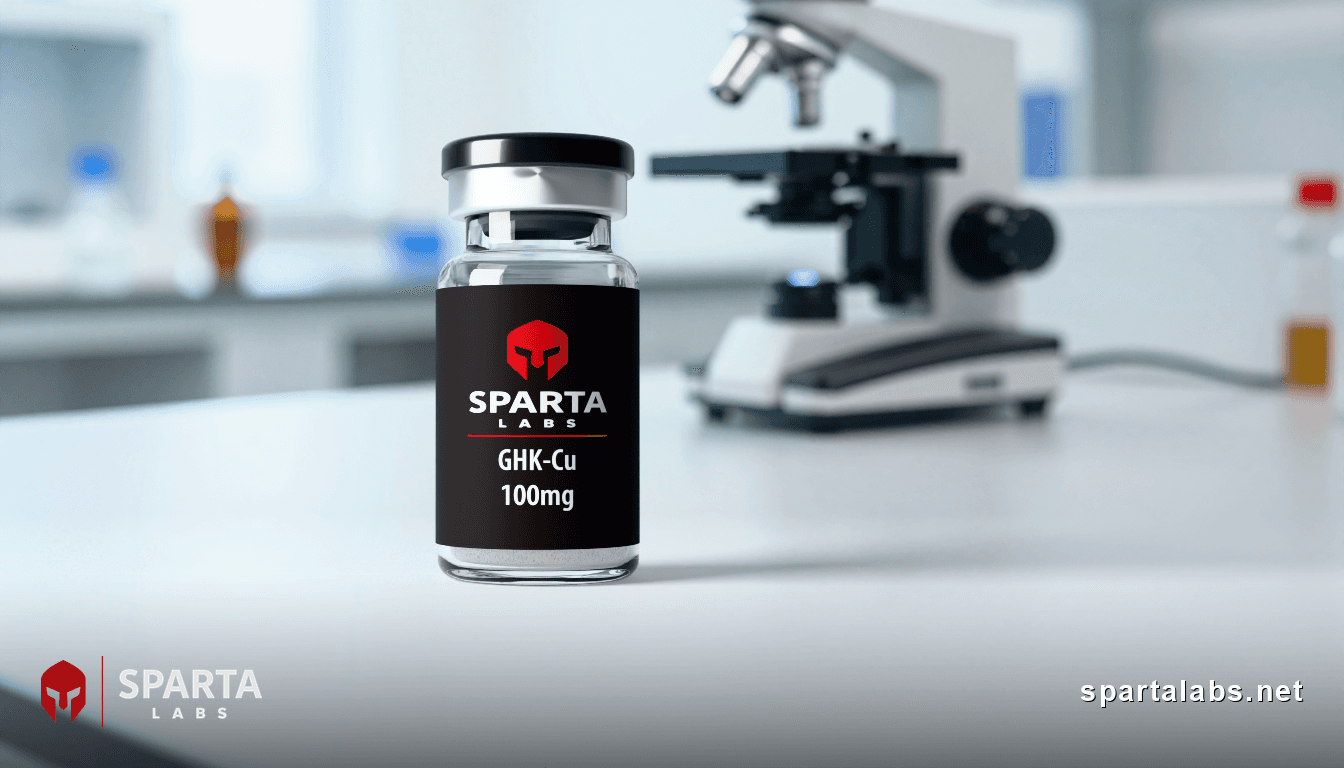
A research peptide is a synthetic peptide supplied as an RUO laboratory material. It has not been reviewed by the FDA for any use, it is not prepared or dispensed under prescription, and its supplier makes no claim about its effects. Its status rests entirely on its intended use being confined to research, judged under 21 CFR 201.128 by all the circumstances of its marketing. A research peptide may share a sequence with an approved or compounded drug; it does not share their legal position. It is not peptide therapy, and nothing about it, including its analytical purity, makes it a substitute for a drug. What an RUO catalog can legitimately offer is documentation of what a material is: for instance, GHK-Cu reference material listed with a per-batch certificate of analysis reporting HPLC purity and mass-spectrometry identity, as described in the guide to certificates of analysis and third-party testing.
A brief history of peptide therapeutics
The peptide-drug field is conventionally dated from insulin. Banting, Best, Collip, and Campbell published "Pancreatic Extracts in the Treatment of Diabetes Mellitus" in the Canadian Medical Association Journal in March 1922, reporting the extract work carried out at the University of Toronto [15]. Lau and Dunn open their historical account of therapeutic peptides with "the advent of insulin therapy in the 1920s" [11], and Muttenthaler and colleagues frame the modern field as beginning "since the introduction of insulin almost a century ago" [10].
The decades that followed were shaped by chemistry as much as biology. Merrifield's solid-phase peptide synthesis, reported in 1963, made it practical to assemble defined sequences on a resin support and later underpinned both research-scale and manufacturing-scale production [16]. Muttenthaler and colleagues describe the field's progression from early work on human hormones through rational medicinal-chemistry design, peptides derived from natural sources, and the molecular-biology and peptide-chemistry advances that continue to expand it [10]. Every product in that lineage that reached patients did so through a regulatory pathway: premarket review for approved drugs, or licensed compounding for compounded ones. The research-peptide category is a product of the same synthetic chemistry, but it was never part of that pathway.
Why the distinction matters
The categories described above differ in what has been evaluated, by whom, and for what. An approved drug has an FDA-reviewed record of safety, effectiveness, and manufacturing quality for a stated indication. A compounded drug has been prepared by a licensed professional on prescription, without FDA premarket review. A research peptide has been characterized analytically, typically by HPLC and mass spectrometry on a batch-specific certificate, and nothing more. Analytical characterization establishes what a material is; it does not establish anything about safety, effects, or suitability for use in a living organism.
That is why a research peptide cannot be described as peptide therapy and cannot be presented as an alternative to it. The intended-use doctrine means that any supplier who framed a research material in those terms would, by that framing, be marketing a drug without approval. Suppliers operating within the RUO category confine themselves to chemistry, published literature, and analytical documentation, and this library observes the same limit.
Regulatory framing
Peptide therapy, as a phrase, belongs to the world of approved and compounded drugs administered by licensed clinicians under the FDCA and the FDA's compounding provisions. Research-use-only peptides are laboratory materials that are not approved for any use in humans or animals, are not drugs, dietary supplements, or foods, and are not an alternative to any medicine. Their classification depends on the intended-use doctrine of 21 CFR 201.128 and the drug definition at 21 U.S.C. 321(g) [8, 9]. The existence of published research on a peptide, or of an approved drug sharing its sequence, does not change the status of research material sold under an RUO designation.
Summary
"Peptide therapy" refers to clinician-administered use of peptide drugs, whether FDA-approved products such as insulin, teriparatide, tesamorelin, and bremelanotide, or drugs compounded on prescription under sections 503A and 503B. US law defines a drug by its intended use, established from all the circumstances of marketing, so the same sequence can be a drug in one setting and a laboratory reagent in another. Research-use-only peptides occupy the latter position: they have not been reviewed by the FDA for any use, are not prescribed or dispensed, and are characterized only analytically. Reviews count more than 80 peptide drugs on the world market since insulin's introduction in 1922, all of which reached patients through a regulatory pathway that research materials have never entered. Research peptides are not peptide therapy, are not for human use, and are not an alternative to it.
References
- U.S. Food and Drug Administration. Drugs@FDA: FORTEO (teriparatide), NDA 021318, original approval November 26, 2002. Drugs@FDA
- U.S. Food and Drug Administration. Drugs@FDA: OZEMPIC (semaglutide), NDA 209637, original approval December 5, 2017. Drugs@FDA
- U.S. Food and Drug Administration. Drugs@FDA: EGRIFTA (tesamorelin for injection), NDA 022505, approved 2010. Drugs@FDA
- U.S. Food and Drug Administration. Vyleesi (bremelanotide injection) prescribing information, NDA 210557, approved June 21, 2019. FDA label
- U.S. Food and Drug Administration. Pitocin (oxytocin injection, USP) synthetic prescribing information, NDA 018261. FDA label
- 21 U.S.C. 353a. Pharmacy compounding (FDCA section 503A). Legal Information Institute, Cornell Law School
- 21 U.S.C. 353b. Outsourcing facilities (FDCA section 503B). Legal Information Institute, Cornell Law School
- 21 U.S.C. 321(g)(1). Federal Food, Drug, and Cosmetic Act, definition of "drug." Legal Information Institute, Cornell Law School
- 21 CFR 201.128. Meaning of "intended uses." Legal Information Institute, Cornell Law School
- Muttenthaler M, King GF, Adams DJ, Alewood PF. Trends in peptide drug discovery. Nat Rev Drug Discov. 2021;20(4):309-325. DOI: 10.1038/s41573-020-00135-8 (PMID: 33536635)
- Lau JL, Dunn MK. Therapeutic peptides: Historical perspectives, current development trends, and future directions. Bioorg Med Chem. 2018;26(10):2700-2707. DOI: 10.1016/j.bmc.2017.06.052 (PMID: 28720325)
- Wang L, Wang N, Zhang W, et al. Therapeutic peptides: current applications and future directions. Signal Transduct Target Ther. 2022;7(1):48. DOI: 10.1038/s41392-022-00904-4 (PMID: 35165272)
- U.S. Food and Drug Administration. Compounding and the FDA: Questions and Answers. FDA
- U.S. Food and Drug Administration. Certain Bulk Drug Substances for Use in Compounding That May Present Significant Safety Risks. FDA
- Banting FG, Best CH, Collip JB, Campbell WR, Fletcher AA. Pancreatic Extracts in the Treatment of Diabetes Mellitus. Can Med Assoc J. 1922;12(3):141-146. PubMed (PMID: 20314060)
- Merrifield RB. Solid Phase Peptide Synthesis. I. The Synthesis of a Tetrapeptide. J Am Chem Soc. 1963;85(14):2149-2154. DOI: 10.1021/ja00897a025
Frequently asked questions
What is peptide therapy?
As the phrase is used in clinical and regulatory contexts, peptide therapy refers to the prescription and administration of peptide drugs by licensed clinicians. Those drugs are either FDA-approved products, such as insulin, teriparatide, or tesamorelin, or drugs compounded for an individual patient under sections 503A or 503B of the Federal Food, Drug, and Cosmetic Act. It is a category of medical practice, not a category of chemical.
What is the difference between peptide therapy and research peptides?
Peptide therapy involves drugs that have either passed FDA review or been compounded by licensed professionals on prescription. Research peptides are research-use-only laboratory materials that have not been reviewed by the FDA for any use, are not prescribed or dispensed, and are not intended for use in humans. The two categories can involve the same amino-acid sequence and still be legally unrelated.
Are research peptides a form of peptide therapy?
No. Research-use-only peptides are not drugs, are not for human use, and are not an alternative to any approved or compounded medicine. Under the FDA's intended-use doctrine, their status as research materials depends on their being labeled, described, and offered solely for laboratory research.
How many peptide drugs has the FDA approved?
Reviews of the field report more than 80 peptide drugs on the world market since insulin, according to Muttenthaler and colleagues in 2021, and over 60 approved in the United States and other major markets, according to Lau and Dunn in 2018. The exact count depends on how peptides are defined and which markets are included.
When did peptide therapeutics begin?
The first peptide therapeutic was insulin. Banting, Best, Collip, and Campbell published their report on pancreatic extracts in the Canadian Medical Association Journal in 1922, and insulin became the reference point from which the modern peptide-drug field is dated. Reviews of therapeutic peptides commonly begin their history at that point.