
Tirzepatide: Sourcing, Purity, and Verification Standards
A sourcing reference for tirzepatide: why its Aib residues and C20 fatty-diacid conjugate shape synthesis, purity analysis, and batch verification. Educational reference.
For research use only. Not for human consumption. This article is educational reference material. It is not medical advice and is not a recommendation to use any substance.
Introduction
Tirzepatide is a 39-residue synthetic peptide engineered as a dual agonist of the glucose-dependent insulinotropic polypeptide (GIP) and glucagon-like peptide-1 (GLP-1) receptors, first described in the peer-reviewed literature by Coskun and colleagues in 2018 [1]. Its research-supply relevance is inseparable from its structure: unlike a plain linear peptide, tirzepatide carries two non-proteinogenic alpha-aminoisobutyric acid (Aib) residues and a C20 fatty-diacid conjugate built on a single lysine side chain. Those features determine how the molecule is assembled, which impurities can arise, and which analytical methods can distinguish the intended compound from close structural variants. Background on the molecule's chemistry and classification is available in the tirzepatide research overview, and its receptor pharmacology is summarized in the tirzepatide mechanism of action article. This reference focuses on what those structural choices mean for sourcing, purity analysis, and batch verification.
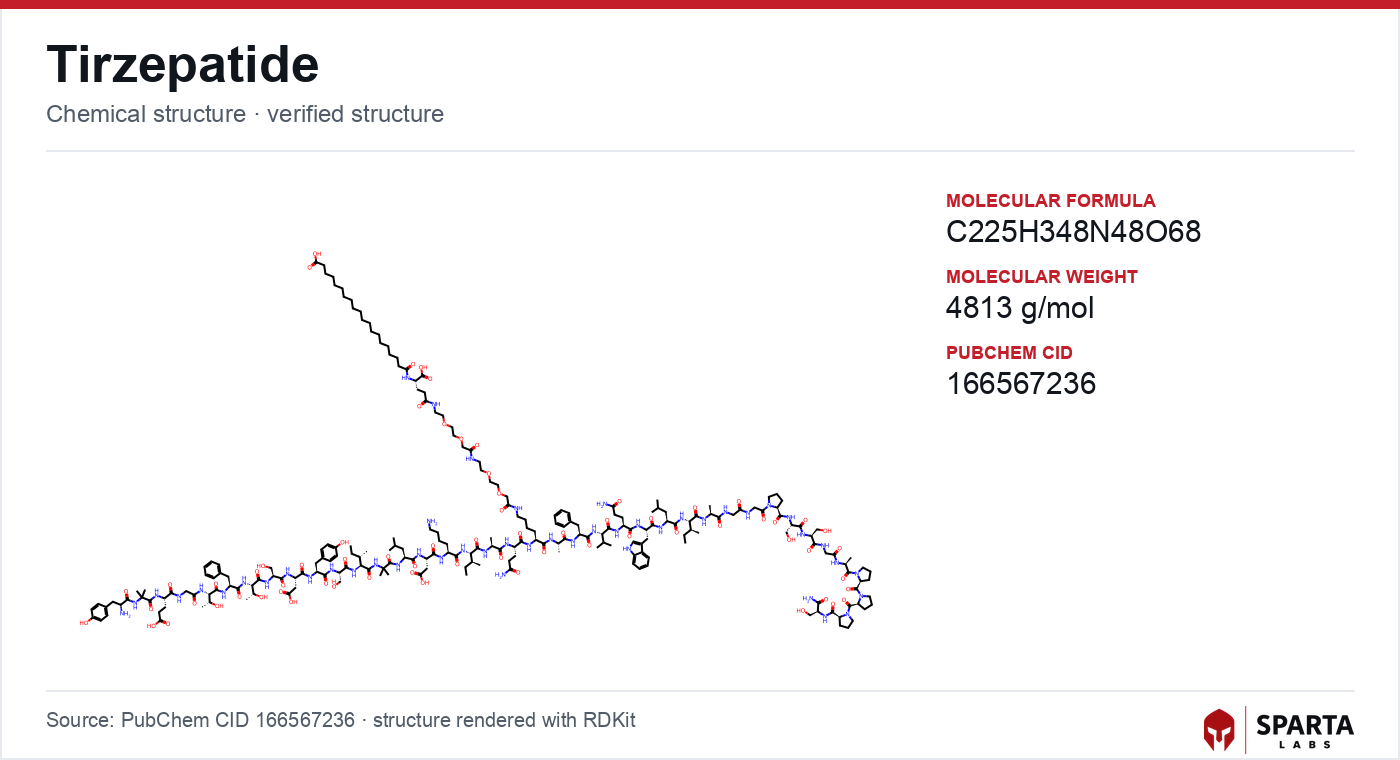
Figure: chemical structure of Tirzepatide.
The Structural Features That Shape Synthesis
Tirzepatide's sequence is based on the GIP backbone and includes two Aib residues, at positions 2 and 13, in place of the residues that render native incretin peptides susceptible to rapid enzymatic cleavage [1]. Aib is a quaternary, sterically hindered amino acid, and coupling to and past hindered residues is a recognized challenge in stepwise chain assembly. The reported observation that Aib substitution reduces susceptibility to dipeptidyl peptidase-4 cleavage is a property described by the discovering researchers in an experimental context [1].
Findings from research models do not establish safety or efficacy in humans. Sparta Labs makes no claims about the use of this compound.
The second defining feature is the lipidation. A C20 fatty diacid is attached to the epsilon-amine of a lysine residue through a gamma-glutamate residue and two 2-(2-aminoethoxy)ethoxy acetic acid (AEEA) spacer units [1]. In biological systems this conjugate is reported to associate with serum albumin, a property the discovering group linked to the molecule's extended circulation profile [1]. From a manufacturing standpoint, the conjugate means the molecule is not finished when the 39-residue chain is complete: the linker and fatty acid must be assembled site-selectively on the intended lysine without modifying the other reactive side chains.
Solid-Phase Assembly of a Conjugated 39-mer
Synthetic peptides of tirzepatide's length are assembled by solid-phase peptide synthesis (SPPS), the resin-supported, stepwise method introduced by Merrifield in 1963 and recognized with the Nobel Prize in Chemistry in 1984 [2]. In SPPS the chain grows one protected residue at a time on an insoluble support, with the protecting-group strategy chosen so that side-chain functionality stays masked until the appropriate step. For a lipidated peptide, that strategy is what allows the conjugate to be built on one specific lysine: an orthogonally protected side chain is unmasked selectively, and the gamma-glutamate, AEEA spacers, and fatty diacid are coupled there while the rest of the molecule remains protected.
The chemistry of side-chain protection and its associated side reactions has been reviewed in detail by Isidro-Llobet, Álvarez, and Albericio, whose analysis catalogs the trade-offs and failure modes of protecting-group selection in modern peptide synthesis [3]. Two of those failure modes are directly relevant to a sequence of tirzepatide's composition: aspartimide formation at aspartate-containing motifs and epimerization at hindered coupling sites. Both generate species that differ subtly from the target and that release testing is designed to resolve.
Scale introduces further considerations. Andersson and colleagues described the process-development challenges of moving peptide synthesis from bench to industrial scale, including the handling of lipophilic building blocks and the analytical burden they impose [4]. The same principles govern research-grade production: correct conjugation chemistry and sequence fidelity must be demonstrated analytically before material is released. The general solid-phase methodology and analytical logic described here also apply to other lipidated incretin-class peptides, such as semaglutide and the related dual agonist mazdutide.
Impurity Classes Specific to a Lipidated Peptide
Purity assessment for synthetic peptides is anchored on reversed-phase HPLC, which separates the target from impurities according to differential retention on a stationary phase and reports the fraction of eluted material attributable to the target compound. For tirzepatide, the impurity classes worth distinguishing extend beyond the deletion and truncation sequences common to any long peptide.
- Sequence-related impurities: deletion peptides from incomplete couplings, and single-residue substitutions, which are the baseline concern for a 39-mer assembled through dozens of sequential steps.
- Aib-associated impurities: incomplete coupling at or past the sterically hindered Aib residues, which can leave truncated or des-Aib species.
- Aspartimide and epimerization products: side reactions catalyzed during synthesis and deprotection that yield diastereomers and ring-closed variants [3].
- Lipidation-related impurities: incomplete conjugation (peptide lacking the C20 linker), linker regiochemistry errors, and conjugation at an unintended amine.
The lipidation category is the reason chromatographic purity alone is not a complete identity check for this molecule. Some incorrectly lipidated variants differ from tirzepatide only in the linker region and can elute close to the target, so a purity percentage must be read alongside orthogonal identity data.
Mass Spectrometry and Orthogonal Identity Confirmation
Mass spectrometry (MS) establishes molecular identity independently of chromatographic behavior by measuring whether the observed mass matches the theoretical mass of the intact conjugate. For tirzepatide, the target average molecular mass is approximately 4,813 daltons; a species that is chromatographically similar but structurally distinct, such as one missing the fatty-diacid conjugate or carrying a sequence deletion, resolves as a different mass. This is why MS confirmation is paired with HPLC rather than treated as optional: the two methods answer different questions, purity versus identity.
Residual-solvent analysis addresses carry-through of reagents used in synthesis and purification, including trifluoroacetic acid and acetonitrile, so that identified peaks are characterized rather than assumed. Where an in vitro or cellular research context is intended, endotoxin screening by the limulus amebocyte lysate (LAL) assay or a recombinant equivalent addresses potential bacterial lipopolysaccharide contamination that would otherwise confound cell-based experiments. Compendial frameworks such as the United States Pharmacopeia general chapters on synthetic peptide impurities describe the analytical logic of characterizing and controlling such species, and research-grade release testing follows the same orthogonal-method principle.
Batch Verification and the Certificate of Analysis
Internal quality control performed by a manufacturer is necessary but is not, on its own, an independent record. Third-party testing at an analytical laboratory with no commercial stake in the outcome provides a separate dataset supporting the purity and identity associated with a batch. Each batch of Sparta Labs tirzepatide is analyzed by third-party HPLC and mass spectrometry, and those results form the basis of the Certificate of Analysis (COA) issued for that batch.
Sparta Labs applies an internal HPLC purity standard of at least 98 percent for tirzepatide, with each batch analytically confirmed before release. The COA for a given batch documents:
- HPLC purity percentage and chromatographic data
- Mass-spectrometry confirmation of molecular weight
- Batch number and manufacturing date
- Expiry date
- Third-party laboratory identification
The COA for each batch is accessible directly from the tirzepatide product page, so that the material in hand can be matched to a specific, analytically characterized batch. Material for which a complete COA cannot be provided is not released. A summary of the published studies that characterized this compound is collected in the tirzepatide published research article.
Storage and Stability Considerations
Tirzepatide, like other synthetic peptides, is supplied in lyophilized (freeze-dried) form because the dry solid is substantially more stable than a solution. General principles of protein and peptide pharmaceutical stability have been reviewed by Manning and colleagues, who catalog the physical and chemical degradation routes relevant to peptide products, including deamidation, oxidation, and aggregation [5]. For a lipidated peptide, both the peptide backbone and the fatty-acid conjugate represent potential sites of chemical change under thermal or oxidative stress, which is why lyophilized material is kept at the temperature indicated on the COA and product label, protected from light and humidity, and shielded from repeated thermal cycling.
Once a peptide is in solution, its degradation rate rises relative to the dry state, and repeated freeze-thaw cycling of prepared solutions is a documented source of measurable loss of intact peptide [5]. Handling that minimizes freeze-thaw exposure is therefore a general consideration for research applications where batch-to-batch and vial-to-vial consistency matters to the interpretation of results.
Why Analytical Rigor Matters for Reproducibility
The reliability of a research finding is bounded by the reliability of the material used to generate it. For a structurally complex molecule such as tirzepatide, a substance that resembles the target chromatographically but differs in the lipid conjugate or the backbone sequence would not be expected to reproduce the pharmacological profile characterized in the primary literature [1]. Such a mismatch introduces a confound that is invisible without orthogonal identity testing, which is precisely why HPLC and mass spectrometry are treated as complementary rather than interchangeable for this class of compound.
Sparta Labs' approach, combining internal HPLC and MS analysis, independent third-party verification, batch-specific COA publication, and transparent access to the analytical record, is designed to provide a defined, characterized starting point. Verified material is the first precondition for reproducible work, and it is the aspect of experimental design that sourcing directly controls.
References
-
Coskun T, Sloop KW, Loghin C, Alsina-Fernandez J, Urva S, Bokvist KB, et al. LY3298176, a novel dual GIP and GLP-1 receptor agonist for the treatment of type 2 diabetes mellitus: from discovery to clinical proof of concept. Mol Metab. 2018;18:3-14. DOI: 10.1016/j.molmet.2018.09.009. Full text via DOI
-
Merrifield RB. Solid phase peptide synthesis. I. The synthesis of a tetrapeptide. J Am Chem Soc. 1963;85(14):2149-2154. DOI: 10.1021/ja00897a025. Full text via DOI
-
Isidro-Llobet A, Álvarez M, Albericio F. Amino acid-protecting groups. Chem Rev. 2009;109(6):2455-2504. PMID: 19364121. DOI: 10.1021/cr800323s. Full text via DOI
-
Andersson L, Blomberg L, Flegel M, Lepsa L, Nilsson B, Verlander M. Large-scale synthesis of peptides. Biopolymers. 2000;55(3):227-250. PMID: 11074440. DOI: 10.1002/1097-0282(2000)55:3<227::AID-BIP50>3.0.CO;2-7. Full text via DOI
-
Manning MC, Chou DK, Murphy BM, Payne RW, Katayama DS. Stability of protein pharmaceuticals: an update. Pharm Res. 2010;27(4):544-575. PMID: 20143256. DOI: 10.1007/s11095-009-0045-6. Full text via DOI
Disclaimer. Statements in this article have not been evaluated by the Food and Drug Administration. This compound is not intended to diagnose, treat, cure, or prevent any disease. Sparta Labs sells research-use-only materials. Content is provided for educational and informational purposes only and does not constitute medical advice. Consult a qualified medical professional for any health concerns.
Frequently asked questions
What makes tirzepatide harder to synthesize than a typical research peptide?
Tirzepatide is a 39-residue peptide that combines two non-standard alpha-aminoisobutyric acid (Aib) residues with a C20 fatty-diacid conjugate attached through a gamma-glutamate and two AEEA spacer units to a single lysine side chain. Assembling the backbone, then site-selectively building the lipid linker on the correct residue, adds conjugation and protecting-group steps beyond a plain sequence. Each added step is a potential source of a characterized impurity that analytical release testing is designed to detect.
Which analytical methods confirm the identity of a tirzepatide batch?
Reversed-phase high-performance liquid chromatography (HPLC) resolves the target peptide from sequence-related and lipidation-related impurities and reports a purity percentage. Mass spectrometry independently confirms that the measured mass matches the theoretical mass of the intact conjugate, distinguishing tirzepatide from truncated or incorrectly lipidated species that can co-elute. Used together, the two methods address purity and molecular identity as separate questions.
Why does the fatty-acid conjugate matter for purity assessment?
The C20 diacid linker introduces impurity pathways that unmodified peptides do not have, including incomplete conjugation, linker regiochemistry errors, and lysine mislabeling. Because some of these variants differ from tirzepatide only in the lipid region, chromatographic similarity alone is not sufficient, and mass-spectrometric confirmation of the conjugate mass carries added weight for a molecule of this structure.
What information does a tirzepatide Certificate of Analysis document?
A batch Certificate of Analysis records the HPLC purity percentage with chromatographic data, mass-spectrometry confirmation of molecular weight, the batch number and manufacturing date, an expiry date, and the identity of the third-party laboratory that performed independent testing. Sparta Labs does not release material for which a complete Certificate of Analysis cannot be provided.