
Tirzepatide: Discovery and Regulatory History
A four-movement research-library history of tirzepatide, from the century-old incretin puzzle and the isolation of GIP and GLP-1 through LY3298176's dual-receptor design and a compressed regulatory record. Educational reference.
For research use only. Not for human consumption. This article is educational reference material. It is not medical advice and is not a recommendation to use any substance.
From an Enzymatic Puzzle to a Twin-Incretin Molecule
Tirzepatide (development code LY3298176) is a synthetic, once-weekly peptide engineered to engage two distinct gut-hormone receptors within a single amino-acid chain. Its regulatory record is unusually compressed for a peptide of this complexity: fewer than four years separated its first published human data from a second distinct FDA approval. Yet the scientific groundwork on which it rests stretches back more than a century, to the earliest attempts to explain why the digestive tract seemed to "prime" the pancreas.
This history traces that lineage in four movements: the physiological puzzle of the incretin effect and the isolation of the two hormones that resolved it; the pharmacological pivot that turned those hormones into a design blueprint; the compressed clinical program that carried LY3298176 through the regulatory record; and the ongoing investigational landscape that has grown up around the first approved dual incretin agonist. The account is built from primary literature and official FDA documents.
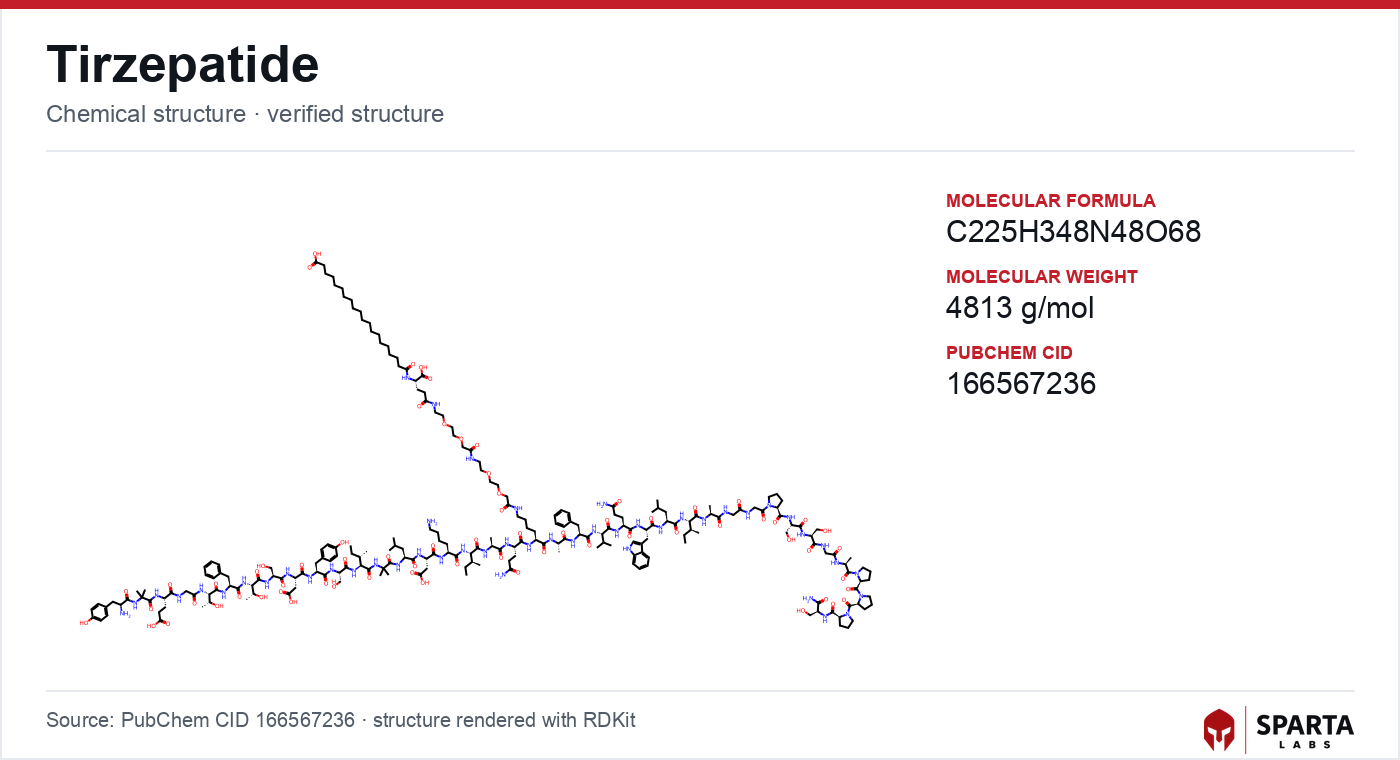
Figure: chemical structure of Tirzepatide.
The Incretin Effect and Its Two Hormones (1900s–1980s)
The observation at the root of tirzepatide's design was recorded long before its molecular basis was understood. Early-twentieth-century physiologists noted that glucose taken by mouth provoked a considerably larger insulin response than the same quantity of glucose delivered intravenously. This difference, later termed the incretin effect, implied that the gut released a signal that amplified the pancreatic response to nutrients. Identifying that signal took the better part of the century.
The first of the two responsible hormones was isolated in the early 1970s by John Brown and colleagues at the University of British Columbia. It was initially named for an observed capacity to inhibit gastric acid secretion, but continued study established that its dominant physiological role was potentiating glucose-stimulated insulin release. The peptide was accordingly renamed glucose-dependent insulinotropic polypeptide (GIP), a 42-amino-acid hormone secreted by enteroendocrine K cells of the proximal small intestine after a meal.
The second hormone emerged from molecular biology rather than classical endocrinology. In 1983, Graeme Bell's laboratory at the University of Chicago cloned the proglucagon gene, revealing that a single precursor encoded several peptides. Investigators including Joel Habener, Svetlana Mojsov, Daniel Drucker, and Jens Juul Holst then showed that tissue-specific processing of proglucagon in the intestine liberated glucagon-like peptide-1 (GLP-1), a potent insulinotropic peptide released by enteroendocrine L cells of the distal gut. A defining and consequential property of GLP-1 was its brevity in circulation: rapid inactivation by the enzyme dipeptidyl peptidase-4 (DPP-4) gave the native peptide a plasma half-life measured in minutes, a limitation that would shape every later attempt to turn it into a durable pharmacological agent.
Turning Two Hormones Into a Design Brief (1990s–2010s)
Through the 1990s, the therapeutic reasoning around the incretins diverged along the two pathways. GLP-1 receptor agonism attracted the earlier and more sustained pharmaceutical interest, because pharmacological receptor stimulation was reported to modulate glucose handling and reduce food intake in research models. The central obstacle was engineering: how to defeat the peptide's rapid DPP-4 inactivation and extend receptor engagement long enough for weekly administration. Solving that half-life problem became the through-line of an entire class, and the parallel development of the GLP-1 mono-agonist semaglutide illustrates how far the field carried that engineering effort.
GIP followed a quieter course. Its role in incretin physiology was not in dispute, but GIP-based pharmacology did not initially yield candidates with the clinical traction of GLP-1 agonists. What changed the calculus was a body of preclinical work indicating that the two incretin pathways were complementary rather than redundant, and that engaging both receptors at once might produce metabolic effects beyond those reachable by GLP-1 receptor agonism alone. That hypothesis reframed GIP from a stalled target into half of a design brief for a single dual-receptor molecule.
The formal scientific introduction of that molecule arrived in 2018, when Tinh Coskun and colleagues at Eli Lilly and Company published its design and early characterization in Molecular Metabolism [1]. They described LY3298176 as a 39-amino-acid peptide built on a GIP-based backbone, fitted with a C20 fatty-diacid moiety that promotes albumin binding and confers the extended plasma half-life required for weekly dosing.
Findings from research models do not establish safety or efficacy in humans. Sparta Labs makes no claims about the use of this compound.
The same report presented first-in-human pharmacokinetic data, documenting a half-life compatible with extended dosing intervals that anchored the schedule used throughout the later clinical program [1]. The structural logic behind that dual-receptor design is examined in the tirzepatide mechanism of action article.
The Compressed Clinical Program (2018–2023)
Early-phase development and dose finding
LY3298176 entered human testing in phase 1 studies in the late 2010s, with pharmacokinetic findings reported in the 2018 Coskun paper informing the dosing intervals adopted downstream [1]. A phase 2 dose-finding study in adults with type 2 diabetes then provided early evidence of dose-dependent effects on glycemic and weight-related endpoints, and the dose range validated there was carried forward into the pivotal trials.
SURPASS: the diabetes program
The phase 3 program in type 2 diabetes, designated SURPASS-1 through SURPASS-5, was conducted across international sites and enrolled adults at different stages of the treatment continuum. The trials compared tirzepatide against placebo and active comparators including semaglutide, insulin degludec, and insulin glargine over 40- to 52-week periods [2,3,4]. SURPASS-2 (Frías et al., 2021) was notable methodologically as a head-to-head comparison against once-weekly semaglutide [3], while SURPASS-4 (Del Prato et al., 2021) enrolled participants at elevated cardiovascular risk and used insulin glargine as its comparator [4]. Collectively the SURPASS trials generated the efficacy and safety dataset the FDA reviewed for the diabetes indication.
First approval: Mounjaro, May 2022
The FDA approved tirzepatide as Mounjaro on May 13, 2022, under NDA 215866, as an adjunct to diet and exercise to improve glycemic control in adults with type 2 diabetes mellitus [5]. The approval designated tirzepatide as the first FDA-cleared medication in the dual GIP and GLP-1 receptor agonist class, marking the point at which the twin-incretin design hypothesis entered the regulatory record as an approved therapy.
SURMOUNT and the second approval: Zepbound, November 2023
A parallel phase 3 program, SURMOUNT, investigated tirzepatide beyond the diabetes indication. SURMOUNT-1 (Jastreboff et al., 2022) was a 72-week placebo-controlled trial in adults without type 2 diabetes [6], and SURMOUNT-2 (Garvey et al., 2023) examined participants with concurrent type 2 diabetes over the same duration [7]. On November 8, 2023, the FDA approved tirzepatide under the brand name Zepbound for chronic weight management in adults meeting specified body-mass-index criteria, as an adjunct to a reduced-calorie diet and physical activity [8]. This second distinct approval, arriving roughly eighteen months after the first, represented the first regulatory clearance of a dual GIP and GLP-1 receptor agonist for a weight-management indication.
A Third Milestone and the Shortage-List Question (2024)
In December 2024, the FDA approved an additional indication for Zepbound covering moderate-to-severe obstructive sleep apnea in adults with obesity, supported by data from the SURMOUNT-OSA program. This was the first pharmacological therapy cleared in the United States for that condition and constituted a third distinct regulatory milestone for the tirzepatide record within a compressed timeframe.
A separate 2024 development carried implications less for indications than for supply and manufacturing oversight: the FDA removed tirzepatide from its drug-shortage list, reflecting the program's commercial scale-up. That status change bears directly on the compounding landscape under the 503A and 503B pharmacy frameworks and has featured prominently in regulatory discussion of the compound's standing in the United States. The verification and quality-control considerations that attend research-use material are examined in the tirzepatide sourcing and quality article.
The Investigational Landscape After First Approval
Tirzepatide has remained an active research subject well past its initial approvals. A dedicated cardiovascular outcomes trial (SURPASS-CVOT) was registered and enrolling, pediatric efficacy and safety data were generated in the SURPASS-PEDS trial, and investigational programs in additional cardiometabolic conditions, including metabolic dysfunction-associated steatohepatitis and heart failure with preserved ejection fraction, advanced through early- and late-phase stages.
Its position as the first approved dual incretin agonist has also reframed a mechanistic debate that predates the molecule itself: how much of the observed pharmacology should be attributed to GIP-receptor versus GLP-1-receptor engagement. That question has propelled a further generation of multireceptor candidates, from the triple GIP/GLP-1/glucagon agonist retatrutide to amylin-based combination strategies such as cagrilintide. For a broader synthesis of tirzepatide's chemistry, classification, and pharmacology, the tirzepatide research overview consolidates the primary literature, and batch-specific Certificate of Analysis data for non-clinical investigation is documented on the tirzepatide product page.
References
-
Coskun T, Sloop KW, Loghin C, Alsina-Fernandez J, Urva S, Bokvist KB, et al. LY3298176, a novel dual GIP and GLP-1 receptor agonist for the treatment of type 2 diabetes mellitus: from discovery to clinical proof of concept. Mol Metab. 2018;18:3-14. DOI: 10.1016/j.molmet.2018.09.009
-
Rosenstock J, Wysham C, Frías JP, Kaneko S, Lee CJ, Fernández Landó L, et al. Efficacy and safety of a novel dual GIP and GLP-1 receptor agonist tirzepatide in patients with type 2 diabetes (SURPASS-1): a double-blind, randomised, phase 3 trial. Lancet. 2021;398(10295):143-155. DOI: 10.1016/S0140-6736(21)01324-6
-
Frías JP, Davies MJ, Rosenstock J, Pérez Manghi FC, Fernández Landó L, Bergman BK, et al. Tirzepatide versus semaglutide once weekly in patients with type 2 diabetes. N Engl J Med. 2021;385(6):503-515. PMID: 34170647. DOI: 10.1056/NEJMoa2107519
-
Del Prato S, Kahn SE, Pavo I, Wander PL, Chen Y, Landó LF, et al. Tirzepatide versus insulin glargine in type 2 diabetes and increased cardiovascular risk (SURPASS-4): a randomised, open-label, parallel-group, multicentre, phase 3 trial. Lancet. 2021;398(10313):1811-1824. DOI: 10.1016/S0140-6736(21)02188-7
-
US Food and Drug Administration. Mounjaro (tirzepatide) injection: NDA 215866 approval letter. May 13, 2022. Available at: Source: accessdata.fda.gov
-
Jastreboff AM, Aronne LJ, Ahmad NN, Wharton S, Connery L, Alves B, et al. Tirzepatide once weekly for the treatment of obesity. N Engl J Med. 2022;387(3):205-216. PMID: 35658024. DOI: 10.1056/NEJMoa2206038
-
Garvey WT, Frías JP, Jastreboff AM, le Roux CW, Sattar N, Li T, et al. Tirzepatide once weekly for the treatment of obesity in people with type 2 diabetes (SURMOUNT-2): a double-blind, randomised, multicentre, placebo-controlled, phase 3 trial. Lancet. 2023;402(10402):613-626. DOI: 10.1016/S0140-6736(23)01200-X
-
US Food and Drug Administration. FDA approves new medication for chronic weight management. Press announcement. November 8, 2023. Available at: Source: fda.gov
Disclaimer. Statements in this article have not been evaluated by the Food and Drug Administration. This compound is not intended to diagnose, treat, cure, or prevent any disease. Sparta Labs sells research-use-only materials. Content is provided for educational and informational purposes only and does not constitute medical advice. Consult a qualified medical professional for any health concerns.
Frequently asked questions
When was tirzepatide first described in the scientific literature?
The foundational characterization of tirzepatide, then designated LY3298176, was published in 2018 by Tinh Coskun and colleagues at Eli Lilly and Company in Molecular Metabolism. That report described its dual-receptor design, preclinical pharmacology, and first-in-human pharmacokinetic data. Its scientific lineage, however, reaches back through more than five decades of GIP and GLP-1 research.
Why is tirzepatide called a dual incretin receptor agonist?
Tirzepatide is a single 39-amino-acid peptide engineered to engage both the GIP receptor and the GLP-1 receptor, the two incretin-hormone receptors identified over the twentieth century. Preclinical research had indicated the two incretin pathways were complementary, which motivated the design of one molecule acting at both. It was the first compound of this dual-agonist class to enter the FDA record.
What were the SURPASS and SURMOUNT clinical programs?
SURPASS was the phase 3 program in type 2 diabetes, comprising trials SURPASS-1 through SURPASS-5 that compared tirzepatide against placebo, semaglutide, and insulin comparators. SURMOUNT was the parallel program investigating tirzepatide in adults with obesity or overweight, including the 72-week SURMOUNT-1 and SURMOUNT-2 trials. Each program generated a distinct dataset that the FDA reviewed.
What are tirzepatide's FDA approval milestones?
The FDA approved tirzepatide as Mounjaro on May 13, 2022 for glycemic control in adults with type 2 diabetes (NDA 215866), the first approval in the dual GIP and GLP-1 receptor agonist class. A second approval as Zepbound followed on November 8, 2023 for chronic weight management. In December 2024, a third indication covering obstructive sleep apnea in adults with obesity was approved.
Why does the 2024 shortage-list removal matter historically?
In 2024 the FDA removed tirzepatide from its drug-shortage list, reflecting the program's commercial scale-up. That status change carries implications for compounding under the 503A and 503B pharmacy frameworks and has featured prominently in regulatory discussion of the compound's standing in the United States. It marks a shift in the record from clinical development toward supply and manufacturing oversight.