
Semaglutide: Sourcing, Purity, and Verification Standards
Why semaglutide's Aib substitution and C18 diacid acyl chain complicate synthesis and analytical identity confirmation, and how batch-level verification addresses it. Educational reference.
For research use only. Not for human consumption. This article is educational reference material. It is not medical advice and is not a recommendation to use any substance.
Introduction
Semaglutide is a 31-amino-acid glucagon-like peptide-1 (GLP-1) receptor agonist derived from the GLP-1(7-37) sequence, engineered with two structural modifications that dominate every sourcing and quality-control decision made about it: a non-proteinogenic residue at position 8 and a long, branched fatty-acid side chain conjugated to the peptide backbone. These features are why semaglutide cannot be treated, for analytical purposes, as an ordinary linear peptide. This article describes how that specific chemistry shapes the synthesis route, the analytical methods used to confirm identity and purity, and the batch documentation Sparta Labs provides for research applications. Background on the compound's pharmacological classification is available in the semaglutide research overview, and the receptor-level pharmacology is discussed in the semaglutide mechanism of action article.
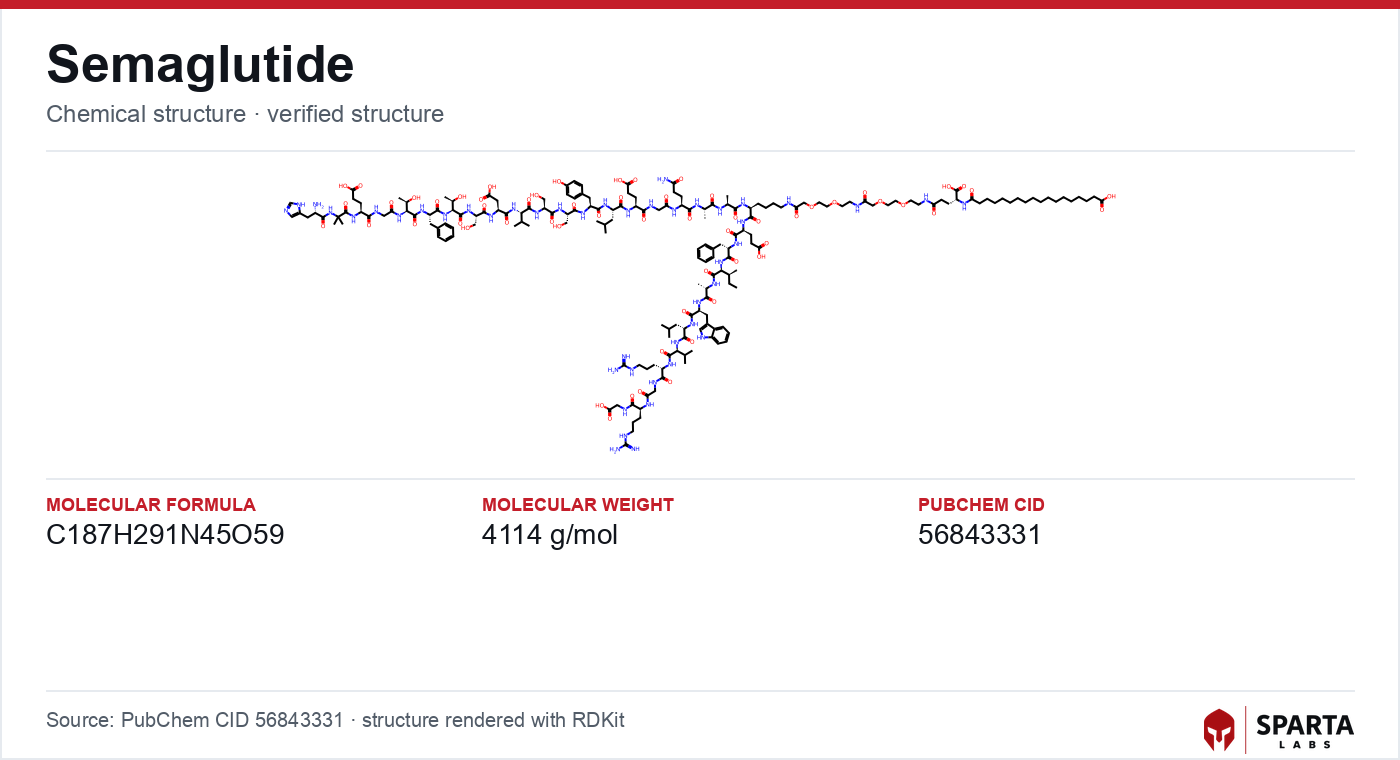
Figure: chemical structure of Semaglutide.
The Two Structural Features That Define Semaglutide Quality Control
Semaglutide was reported by Lau and colleagues in a 2015 paper in the Journal of Medicinal Chemistry, which set out the molecular design in detail [1]. Two modifications distinguish it from native GLP-1 and from the earlier analogue liraglutide.
Findings from research models do not establish safety or efficacy in humans. Sparta Labs makes no claims about the use of this compound.
The first modification is the substitution of alpha-aminoisobutyric acid (Aib) for alanine at position 8. Aib is a non-proteinogenic, alpha,alpha-disubstituted amino acid; its two methyl groups sterically shield the adjacent peptide bond. In the design rationale reported by Knudsen and Lau, this substitution was introduced to reduce cleavage at a site targeted by dipeptidyl peptidase-4 [2].
The second modification is a lipidation at the lysine in position 26. Rather than a simple fatty acid, semaglutide carries a C18 fatty diacid (octadecanedioic acid) attached through a gamma-glutamic acid unit and two 8-amino-3,6-dioxaoctanoic acid (ADO) spacers [1]. This branched acyl assembly is the structural basis for the compound's albumin binding and is the single most demanding element of its synthesis and analysis.
For a sourcing and quality-control program, these two features mean the analytical target is a specific, well-defined molecule with a molecular formula in the region of C187H291N45O59 and a monoisotopic mass near 4,113 daltons. Any deviation from that target, whether a missing acyl chain, an incomplete spacer, or a backbone truncation, is a defined impurity that analytical methods must be able to resolve and identify.
Synthesis: Backbone Assembly Then Selective Acylation
The peptide backbone is assembled by solid-phase peptide synthesis (SPPS), the technique introduced by Robert Bruce Merrifield in a 1963 paper in the Journal of the American Chemical Society and later recognized with the Nobel Prize in Chemistry [3]. SPPS builds a peptide chain one protected residue at a time on an insoluble resin support, then cleaves and deprotects the finished chain. The scale-up chemistry, resin selection, and purification strategies used for producing peptides of this length were reviewed by Andersson and colleagues in Biopolymers [4].
Semaglutide adds a step that a plain peptide does not require: the branched acyl side chain must be installed selectively at the position-26 lysine without acylating the several other reactive amine groups in the sequence. In practice this is achieved through orthogonal protecting-group strategy on the backbone, so that only the intended side-chain amine is exposed for conjugation, followed by stepwise attachment of the gamma-glutamate linker, the ADO spacers, and the C18 diacid [1]. Incomplete conjugation at any of these sub-steps produces a family of closely related impurities, non-acylated or partially assembled side-chain variants, that a purity method must separate from the target.
Confirming Identity: Why Mass and Chromatography Answer Different Questions
Research-grade characterization of an acylated peptide rests on two independent measurements that should not be conflated.
Reverse-phase high-performance liquid chromatography (HPLC) measures homogeneity: it separates the preparation into peaks and reports what fraction of the detected material corresponds to the main peak versus related species. For semaglutide, the species of interest include the non-acylated backbone, partially acylated intermediates, deletion sequences from incomplete coupling, and diastereomers arising from epimerization during synthesis. Because the acyl chain markedly changes hydrophobicity, acylated and non-acylated forms are generally well resolved on a C18 stationary phase, which is one reason reverse-phase HPLC is well suited to this compound class.
Mass spectrometry answers a different question, identity. Electrospray ionization mass spectrometry (ESI-MS) generates a series of multiply charged ions from which the neutral mass is calculated. Matching the observed mass to the expected value near 4,113 daltons confirms that the main component is the intended acylated molecule rather than a species of the same retention time but different composition. A preparation can be chromatographically homogeneous yet be the wrong molecule; it can also be the correct molecule accompanied by resolvable impurities. Only running both an HPLC purity assessment and an MS identity confirmation addresses both failure modes. The same logic underlies the verification approach described for the related dual agonist in the tirzepatide sourcing and quality article.
Salt Form, Counterions, and Residual Analysis
Semaglutide as isolated from an Fmoc-SPPS route is typically handled as a salt. Trifluoroacetic acid (TFA) is a standard component of the cleavage and reversed-phase purification chemistry, and residual TFA is a recognized quantity to monitor; salt-exchange steps to an acetate form are common where a different counterion is preferred. Residual-solvent analysis therefore covers TFA, acetic acid, and organic solvents carried over from synthesis and purification. Where the intended research context calls for it, endotoxin content can be assessed by the limulus amebocyte lysate (LAL) assay. Each of these measures a different attribute of the isolated material and is reported separately.
Certificates of Analysis and Batch-Level Documentation
Sparta Labs publishes a Certificate of Analysis (COA) for each production batch of semaglutide. A COA records the reverse-phase HPLC purity value together with the method parameters used to obtain it, the ESI-MS identity result stated against the expected molecular mass, and the lot identifier and relevant dates. Reporting the method parameters alongside the purity number matters for a compound like semaglutide, because purity values are only comparable when the gradient, column, and detection wavelength that produced them are known.
The batch COA is accessible from the product page for each active inventory lot, so documentation for institutional records or methods sections can be retrieved directly. Investigators can access semaglutide from Sparta Labs with its batch-level COA on the product page.
Storage Stability of the Lyophilized Solid
Peptides are generally more stable in the lyophilized (freeze-dried) solid state than in solution, where hydrolysis, deamidation, and aggregation proceed more readily. The chemical-degradation pathways relevant to peptide and protein pharmaceuticals, and the storage variables that govern them, were reviewed by Manning and colleagues in Pharmaceutical Research [5]. The controlling factors for a lyophilized peptide are moisture, temperature, and light: dry, cold, dark storage in a sealed container slows the degradation chemistry.
For semaglutide specifically, the acyl side chain is an additional structural element whose integrity contributes to the molecule's defined identity, so preserving the solid against moisture ingress preserves not only the backbone but the lipidated architecture that distinguishes semaglutide from its non-acylated impurities. The general principles from peptide stability science apply directly to the lyophilized research material.
Why Provenance Matters for Reproducible Semaglutide Research
The interpretability of any experiment using a peptide depends on knowing what molecule was actually present. For an acylated GLP-1 analogue, a preparation that contains a substantial fraction of non-acylated or partially acylated material is not simply "lower purity"; it is a mixture of species whose pharmacology differs from the intended compound, which can confound results in receptor-binding or signaling assays. Confirmed identity by mass spectrometry and quantified homogeneity by HPLC, documented per batch, are the baseline conditions for attributing an observed effect to semaglutide rather than to an unspecified companion species. Comparable verification considerations for other members of the incretin class are discussed in the tirzepatide research overview and the cagrilintide sourcing and quality article.
References
-
Lau J, Bloch P, Schäffer L, et al. Discovery of the once-weekly glucagon-like peptide-1 (GLP-1) analogue semaglutide. J Med Chem. 2015;58(18):7370–7380. doi:10.1021/acs.jmedchem.5b00726. PubMed PMID: 26308095. PubMed
-
Knudsen LB, Lau J. The discovery and development of liraglutide and semaglutide. Front Endocrinol (Lausanne). 2019;10:155. doi:10.3389/fendo.2019.00155. PubMed PMID: 31031702. PubMed
-
Merrifield RB. Solid phase peptide synthesis. I. The synthesis of a tetrapeptide. J Am Chem Soc. 1963;85(14):2149–2154. doi:10.1021/ja00897a025.
-
Andersson L, Blomberg L, Flegel M, Lepsa L, Nilsson B, Verlander M. Large-scale synthesis of peptides. Biopolymers. 2000;55(3):227–250. doi:10.1002/1097-0282(2000)55:3<227::AID-BIP50>3.0.CO;2-7. PubMed PMID: 10880843. PubMed
-
Manning MC, Chou DK, Murphy BM, Payne RW, Katayama DS. Stability of protein pharmaceuticals: an update. Pharm Res. 2010;27(4):544–575. doi:10.1007/s11095-009-0045-6. PubMed PMID: 20143256. PubMed
Disclaimer. Statements in this article have not been evaluated by the Food and Drug Administration. This compound is not intended to diagnose, treat, cure, or prevent any disease. Sparta Labs sells research-use-only materials. Content is provided for educational and informational purposes only and does not constitute medical advice. Consult a qualified medical professional for any health concerns.
Frequently asked questions
What makes semaglutide harder to synthesize than a plain peptide?
Semaglutide is not a straightforward linear peptide. Its sequence carries an alpha-aminoisobutyric acid (Aib) substitution at position 8 and, at the lysine in position 26, a C18 fatty diacid attached through a gamma-glutamate and two 8-amino-3,6-dioxaoctanoic acid (ADO) spacer units. Lau and colleagues described this design in the 2015 discovery paper. Assembling the backbone by solid-phase synthesis and then attaching the branched acyl side chain adds selectivity and purification challenges beyond those of an unmodified peptide.
Why is mass spectrometry important for confirming semaglutide identity?
Because the acyl side chain and Aib substitution give semaglutide a distinctive molecular formula (approximately C187H291N45O59, monoisotopic mass near 4,113 Da), electrospray mass spectrometry can confirm that the material has the expected mass and is not a truncated or non-acylated variant. Mass confirmation is independent of the HPLC purity measurement, so the two analyses address different quality questions: identity versus homogeneity.
What related peptide impurities are relevant to a semaglutide preparation?
For an acylated analogue, the impurities of interest include non-acylated or partially acylated backbone, deletion or truncation sequences from incomplete coupling, and diastereomers arising from epimerization during synthesis. Reverse-phase HPLC is used to resolve these species from the target peak. This is why an identity-plus-purity approach, rather than a single measurement, is standard for complex acylated peptides.
How is semaglutide documented on a Certificate of Analysis?
A Certificate of Analysis records the analytical results for one production batch, typically including the reverse-phase HPLC purity value with its method parameters, the mass-spectrometric identity result against the expected molecular mass, and lot and date identifiers. Sparta Labs publishes a batch-level COA on the product page so the documentation can be retrieved without contacting support.