
IGF-1 LR3: Discovery and Regulatory History
IGF-1 LR3 was engineered by deliberately weakening one binding interaction while preserving another. This history traces the somatomedin hypothesis, the Rinderknecht-Humbel sequencing work, the Adelaide analog program behind Long R3 IGF-1, and its footing as a research reagent. Educational reference.
For research use only. Not for human consumption. This article is educational reference material. It is not medical advice and is not a recommendation to use any substance.
Introduction
IGF-1 LR3 (Long Arginine-3 Insulin-like Growth Factor-1, also written Long R3 IGF-1) is unusual among research peptides in that its origin story is one of deliberate molecular engineering rather than natural discovery. It is a designed variant of a naturally occurring protein, built to solve a specific experimental problem that had frustrated researchers studying the insulin-like growth factor system for a decade. Understanding its history therefore means understanding two intertwined narratives: the slow unraveling of the somatomedin hypothesis across the mid-twentieth century, and the rational protein-design work of the early 1990s that produced an analog resistant to the binding proteins that complicate native IGF-1 experiments.
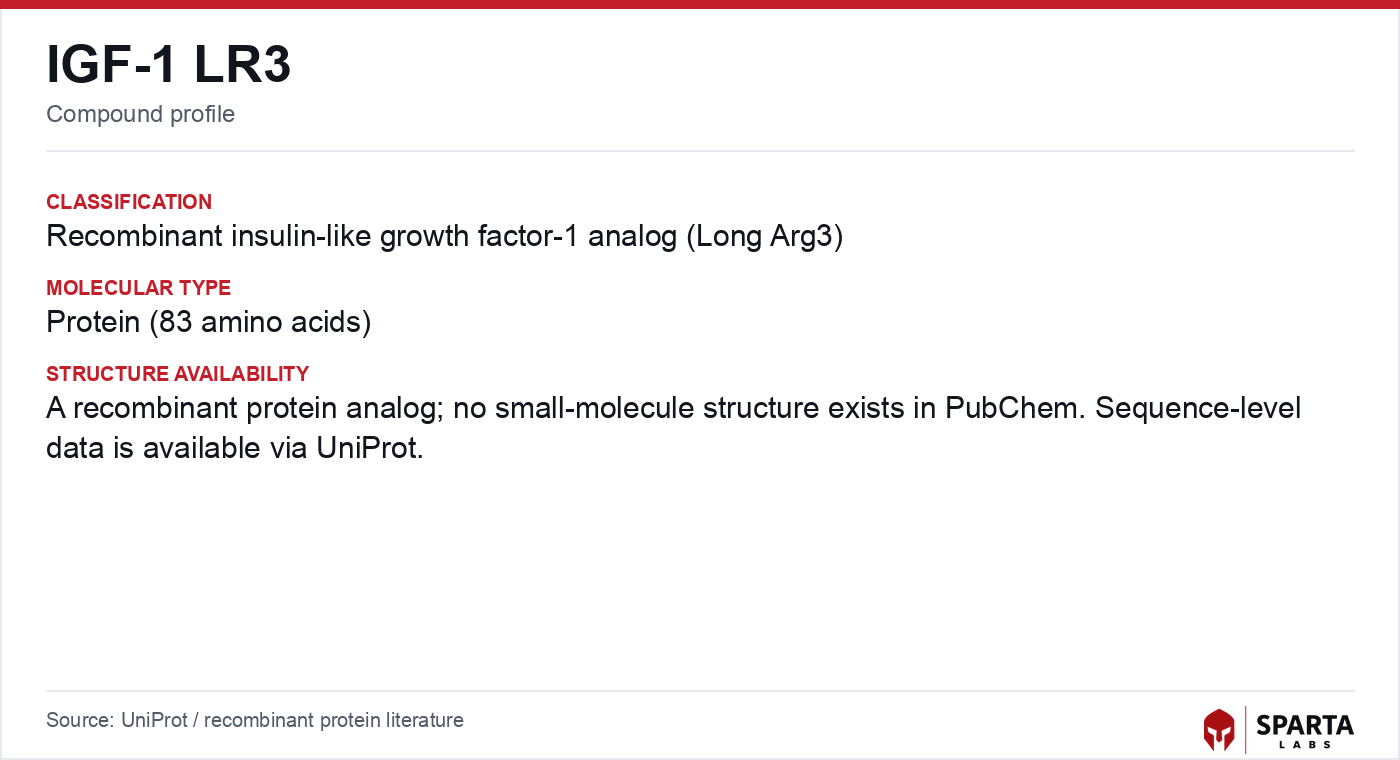
Figure: chemical structure of IGF-1 LR3.
The Somatomedin Puzzle That Preceded the Molecule
The scientific lineage of IGF-1 LR3 traces back to 1957, when Salmon and Daughaday examined how growth hormone stimulates cartilage. Their observation was counterintuitive: growth hormone added directly to rat cartilage did little, whereas serum from growth-hormone-treated animals stimulated sulfate incorporation strongly. They inferred an intermediary serum factor, which they termed "sulfation factor." This gave rise to what became known as the somatomedin hypothesis, the idea that growth hormone acts largely indirectly, through a circulating messenger.
A separate research line was proceeding in parallel in Zurich, where Froesch and colleagues characterized serum fractions that retained insulin-like biological activity even when insulin itself was neutralized by antibodies, a property they called non-suppressible insulin-like activity. For roughly two decades the somatomedin field and the non-suppressible-insulin-like-activity field ran alongside each other, describing what would eventually prove to be the same molecules. The convergence came in 1978, when Rinderknecht and Humbel isolated and sequenced the two principal components from human serum and reported that both were structurally homologous to proinsulin.[1] They renamed them insulin-like growth factor-1 and insulin-like growth factor-2, fixing the nomenclature still used today. IGF-1 LR3 is an analog of the first of these.
Why Native IGF-1 Was Hard to Study
Sequencing IGF-1 opened the molecular biology of the 1980s: the human IGF-1 gene and its receptor were cloned, and the family of IGF-binding proteins was progressively mapped.[2] But that same decade surfaced the experimental obstacle that would eventually motivate IGF-1 LR3. Researchers found that the large majority of circulating IGF-1 does not travel freely. Instead it is held in complex with high-affinity IGF-binding proteins, prominently in a large ternary complex assembled with IGFBP-3 and an acid-labile subunit.[3]
For a pharmacologist, this created a clean methodological problem. Native IGF-1 introduced into a binding-protein-rich system is rapidly captured, so its receptor-mediated biology is difficult to isolate and interpret. Structural studies using alanine-scanning mutagenesis and related mapping approaches had, by this point, indicated that the molecular surfaces of IGF-1 responsible for engaging the binding proteins were partly distinct from those responsible for engaging the type 1 IGF receptor.[3] That separation was the key insight. If the binding-protein surface could be altered without equivalently disrupting the receptor surface, a researcher could obtain a molecule that behaved as a cleaner IGF-1 receptor probe. The stage was set for a designed analog. The receptor pharmacology this enabled is examined in the IGF-1 LR3 mechanism of action article.
The Adelaide Analog Program
The design of Long R3 IGF-1 emerged from research programs associated with the University of Adelaide and affiliated Australian institutions in the late 1980s and early 1990s. Francis and colleagues published the foundational structural and biological characterization of a series of IGF-1 analogs carrying modified affinities for the IGF-binding proteins.[4] The Long R3 member of that series combined two modifications: a 13-residue extension at the N-terminus and a substitution of arginine for the native glutamate at position 3 of the mature sequence. The reported consequence was consistent with what the structural mapping had predicted, markedly reduced affinity for the IGF-binding proteins alongside retained high-affinity binding to the type 1 IGF receptor.
Findings from research models do not establish safety or efficacy in humans. Sparta Labs makes no claims about the use of this compound.
The naming convention encodes the chemistry: "Long" denotes the N-terminal extension and "R3" denotes the arginine at position 3. The compound was subsequently produced as a research reagent by GroPep Ltd, an Adelaide biotechnology company that grew out of the same university research environment. Through the 1990s and 2000s, GroPep supplied Long R3 IGF-1 and related analogs internationally, and the company name recurs in the materials-and-methods sections of published studies from the period, identifying the source of the material used. This provenance is one reason the analog became a widely referenced tool rather than a one-laboratory curiosity; a comparably characterized reagent is easier to cite and reproduce.
Early In Vivo Validation
Once available, the analog was tested to confirm that its designed properties translated into predictable behavior in living systems. Conlon and colleagues reported in 1995 that infusion of Long R3 IGF-1 in guinea pigs was associated with organ-growth changes while concurrently reducing circulating concentrations of endogenous IGF-1, IGF-2, and IGF-binding proteins, a pattern the authors interpreted as consistent with an analog that occupies receptor pathways while itself evading binding-protein sequestration.[5] Results of this kind were important historically because they indicated that the structural logic behind the design held up experimentally, not merely on paper. Additional findings across the published literature are summarized in the IGF-1 LR3 research article.
A Second History: Cell-Culture Manufacturing
IGF-1 LR3 accumulated a second, more industrial history that runs alongside its use as a laboratory probe. Because the analog sustains the growth and viability of cultured mammalian cells at low concentrations and resists binding-protein interference, it became of interest as a component of serum-free cell-culture media. Voorhamme and Yandell reported in 2006 that Long R3 IGF-1 functioned as a more potent alternative to insulin in serum-free culture of HEK293 cells.[6] This positioned the compound as an ingredient candidate in media formulations used for producing recombinant proteins, an application domain tied to the broader growth of biologics manufacturing. This manufacturing lineage is distinct from, and largely independent of, the receptor-biology research narrative, and it is one reason the analog remained in continuous production long after its introduction.
Regulatory Footing and the Mecasermin Parallel
The regulatory history of IGF-1 LR3 itself is straightforward: it is a research reagent and holds no regulatory approval for human therapeutic use. Its documented contribution has been as an enabling tool for the scientific programs that clarified IGF-1 receptor biology.
The adjacent clinical and regulatory story belongs to a different molecule, mecasermin, which is recombinant native-sequence human IGF-1. Mecasermin received FDA approval in 2005 under the brand name Increlex for growth failure in children with severe primary IGF-1 deficiency.[7] That approval affirmed the physiological importance of IGF-1 signaling in human growth regulation and the developability of recombinant IGF-1-class proteins as pharmaceuticals. It is worth keeping the two straight: the approved drug is the unmodified sequence, whereas IGF-1 LR3 is the engineered, binding-protein-resistant analog used in research. Batch-verified IGF-1 LR3 from Sparta Labs is supplied with a certificate of analysis traceable to the specific production run.
The IGF axis intersects with several other growth-hormone-pathway compounds that have their own regulatory arcs. A parallel example is the lipolytic growth-hormone fragment traced in the AOD9604 history article, and the long-acting growth-hormone-releasing analog covered in the CJC-1295 with DAC history article, both of which illustrate how modifications to a native peptide can create distinct research and regulatory trajectories.
The Compound's Enduring Role
Decades after its introduction, IGF-1 LR3 continues to appear in the peer-reviewed literature as a defined-potency IGF-1 receptor agonist across developmental biology, cell biology, and neuroscience research contexts. Its longevity as a reagent rests on the same properties that motivated its design: a well-characterized structure, a documented binding profile relative to native IGF-1, and a substantial body of published work describing its behavior across experimental systems. The structural and classificatory details behind that profile are covered in the IGF-1 LR3 research overview, while contemporary manufacturing and verification standards are documented in the IGF-1 LR3 sourcing and quality article.
References
-
Rinderknecht E, Humbel RE. The amino acid sequence of human insulin-like growth factor I and its structural homology with proinsulin. J Biol Chem. 1978;253(8):2769-76. PMID: 632300. PubMed
-
LeRoith D, Werner H, Beitner-Johnson D, Roberts CT Jr. Molecular and cellular aspects of the insulin-like growth factor I receptor. Endocr Rev. 1995;16(2):143-63. PMID: 7540132. DOI: 10.1210/edrv-16-2-143. PubMed
-
Allard JB, Duan C. IGF-binding proteins: why do they exist and why are there so many? Front Endocrinol (Lausanne). 2018;9:117. PMID: 29686648. PMCID: PMC5900387. DOI: 10.3389/fendo.2018.00117. PubMed
-
Francis GL, Ross M, Ballard FJ, Milner SJ, et al. Novel recombinant fusion protein analogues of insulin-like growth factor (IGF)-I indicate the relative importance of IGF-binding protein and receptor binding for enhanced biological potency. J Mol Endocrinol. 1992;8(3):213-23. PMID: 1378742. DOI: 10.1677/jme.0.0080213. PubMed
-
Conlon MA, Tomas FM, Owens PC, Wallace JC, Howarth GS, Ballard FJ. Long R3 insulin-like growth factor-I (IGF-I) infusion stimulates organ growth but reduces plasma IGF-I, IGF-II and IGF binding protein concentrations in the guinea pig. J Endocrinol. 1995;146(2):247-53. PMID: 7561636. DOI: 10.1677/joe.0.1460247. PubMed
-
Voorhamme D, Yandell CA. LONG R3IGF-I as a more potent alternative to insulin in serum-free culture of HEK293 cells. Mol Biotechnol. 2006;34(2):201-4. PMID: 17172665. DOI: 10.1385/MB:34:2:201. PubMed
-
US Food and Drug Administration. Increlex (mecasermin) injection: NDA 021839. Drugs@FDA
Disclaimer. Statements in this article have not been evaluated by the Food and Drug Administration. This compound is not intended to diagnose, treat, cure, or prevent any disease. Sparta Labs sells research-use-only materials. Content is provided for educational and informational purposes only and does not constitute medical advice. Consult a qualified medical professional for any health concerns.
Frequently asked questions
Where did IGF-1 LR3 come from historically?
IGF-1 LR3, or Long R3 IGF-1, was designed by research groups associated with the University of Adelaide in Australia in the late 1980s and early 1990s. Francis and colleagues published the foundational structural and biological characterization of a series of IGF-1 analogs with modified binding-protein affinities in 1992. The Long R3 variant combined an N-terminal peptide extension with an amino-acid substitution at position 3.
What is the somatomedin hypothesis, and why does it matter for IGF-1 LR3?
The somatomedin hypothesis, articulated after Salmon and Daughaday's 1957 work, proposed that growth hormone acts largely through an intermediary serum factor rather than directly on cartilage. That intermediary was later isolated and sequenced by Rinderknecht and Humbel in 1978 and named insulin-like growth factor-1. IGF-1 LR3 is an engineered analog of that molecule, so its scientific lineage begins with this hypothesis.
What structural change distinguishes Long R3 IGF-1 from native IGF-1?
As reported by Francis and colleagues in 1992, the Long R3 analog carries a 13-residue N-terminal extension together with an arginine-for-glutamate substitution at position 3 of the mature IGF-1 sequence. Published characterization associated these modifications with markedly reduced affinity for IGF-binding proteins while high-affinity binding to the type 1 IGF receptor was retained.
Does IGF-1 LR3 have any regulatory approval history?
IGF-1 LR3 has no regulatory approval for human therapeutic use; its documented history is that of a research reagent. The related clinical development story belongs to mecasermin, recombinant native-sequence human IGF-1, marketed as Increlex, which the FDA approved in 2005 for growth failure in children with severe primary IGF-1 deficiency.