
Pinealon: Published Research
A study-by-study survey of the peer-reviewed literature on the EDR tripeptide (Pinealon), organized by experimental modality: intracellular localization and DNA-interaction work, oxidative-stress cell studies, rodent disease models, and computational promoter-docking analyses.
For research use only. Not for human consumption. This article is educational reference material. It is not medical advice and is not a recommendation to use any substance.
The EDR Tripeptide as a Research Object
Pinealon is the trade designation for the synthetic tripeptide with the sequence glutamyl-aspartyl-arginine (Glu-Asp-Arg), abbreviated EDR in single-letter notation. It belongs to a family of short peptides investigated primarily within the St. Petersburg Institute of Bioregulation and Gerontology, where Vladimir Khavinson and collaborators proposed that ultrashort peptide sequences might act as regulatory signals rather than as structural or nutritive material. The published literature on EDR is therefore concentrated, methodologically consistent, and largely traceable to a defined research lineage, which makes it a useful case study in how a single peptide sequence is characterized across in vitro, computational, and rodent-model work.
This article surveys the verifiable English-language and English-translated peer-reviewed publications on EDR. It is organized by the type of experimental question each cluster of studies addressed rather than by a generic chronology, and it directs readers to the original papers for full methodology and data. Researchers reviewing purity documentation for experimental use can consult the Pinealon product page.
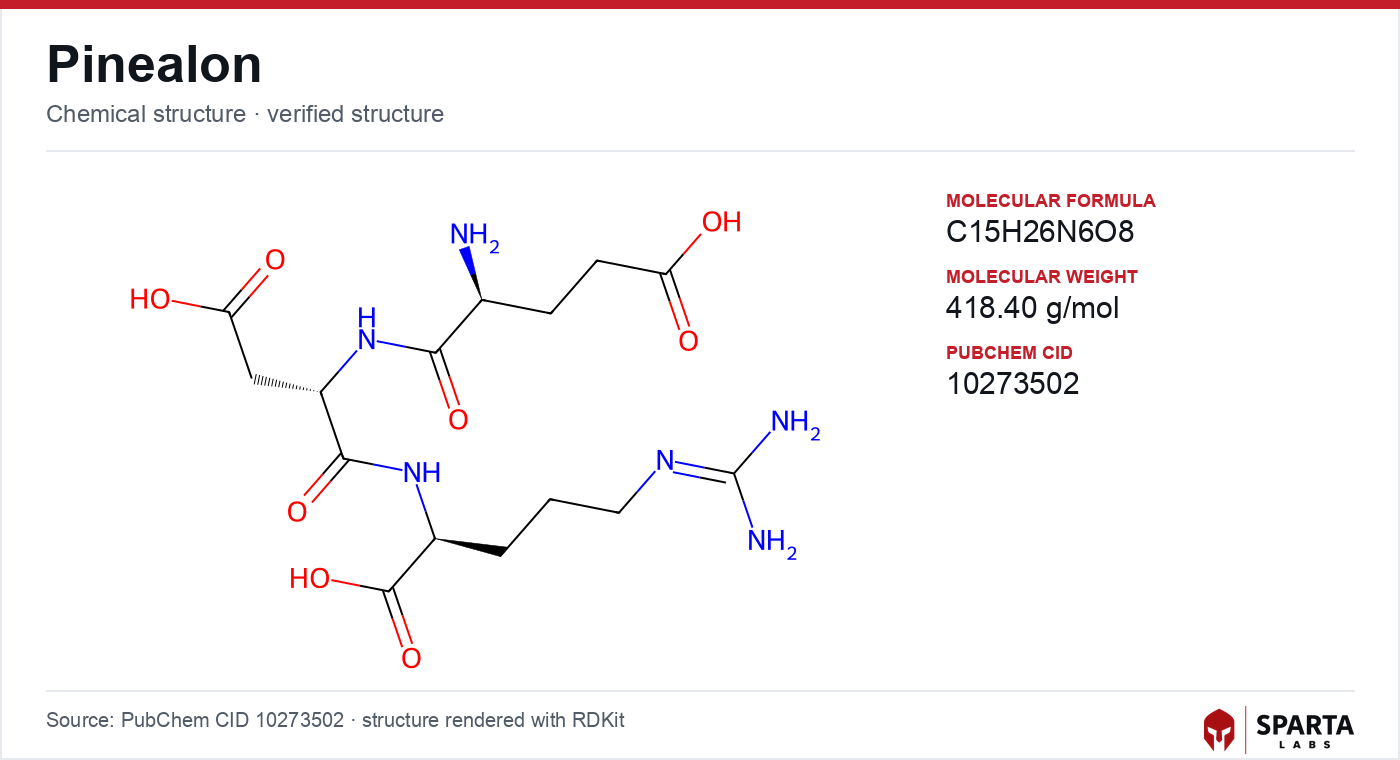
Figure: chemical structure of Pinealon (EDR tripeptide).
How EDR Has Been Studied: Model Systems in the Literature
Three broad experimental modalities recur across the EDR literature, and understanding them clarifies what the citations can and cannot support.
The first is cell-culture work. Published in vitro studies have used neural lines and preparations (cerebellar granule cells, PC12 pheochromocytoma cells, primary hippocampal cultures) alongside non-neural material (HeLa cells, isolated neutrophils). Reported endpoints include reactive oxygen species (ROS) quantification, viability and flow-cytometry partitioning of necrotic versus apoptotic fractions, ERK 1/2 phosphorylation status, and dendritic-spine morphology counts.
The second is computational modeling. Several papers apply molecular docking to estimate binding between the EDR sequence and short DNA oligonucleotides, reporting candidate complementary nucleotide motifs in gene-promoter regions. These are hypothesis-generating analyses, not direct biochemical demonstrations of transcriptional control.
The third is rodent in vivo work, spanning rat models (prenatal hyperhomocysteinemia, bilateral carotid occlusion, streptozotocin-induced diabetes) and transgenic mice (the 5xFAD amyloid line). Behavioral endpoints have centered on Morris water maze performance; biochemical endpoints have included caspase-3 activity and tissue ROS measurements.
Intracellular Localization and the DNA-Interaction Hypothesis
The distinguishing feature of the EDR research program is its proposed genomic mode of action, and the anchoring paper is a 2011 report by Fedoreyeva, Kireev, Khavinson, and Vanyushin in Biochemistry (Moscow) [1]. Using fluorescein-labeled short peptides, the authors reported that labeled peptide, including the EDR sequence, was detectable in the cytoplasm, nucleus, and nucleolus of HeLa cells after incubation, and they described in vitro interaction between the peptides and synthetic deoxyribooligonucleotides, with docking models constructed for multiple peptide-DNA pairs.
Findings from research models do not establish safety or efficacy in humans. Sparta Labs makes no claims about the use of this compound.
This work established the experimental premise that subsequent EDR studies build on: that a tripeptide small enough to enter the nucleus might engage DNA directly rather than through surface-receptor cascades. That premise, and its limits, are discussed further in the Pinealon mechanism of action article. The same conceptual framework underlies the related Khavinson tetrapeptide AEDG, whose parallel literature is summarized in Epithalon published research.
Oxidative-Stress and Cell-Viability Studies
A cluster of reports examined EDR in the context of oxidative challenge. Khavinson and colleagues published findings in Rejuvenation Research in 2011 across rat cerebellar granule cells, human neutrophils, and PC12 cells [2]. The authors reported that peptide exposure was associated with restriction of ROS accumulation induced by oxidative stimuli, together with observations on ERK 1/2 phosphorylation and shifts in the proportion of necrotic cells relative to untreated controls.
An earlier report by Kozina in Advances in Gerontology (2008) examined antihypoxic properties across a set of short regulatory peptides, describing the proposed protective action as engagement of endogenous antioxidant enzyme systems rather than direct radical scavenging [3]. The distinction matters for interpretation: the reported effects in these papers are framed as modulation of the cell's own defensive machinery, a hypothesis that the later docking analyses attempted to connect to specific antioxidant-enzyme gene promoters.
Rodent Models: Development, Ischemia, and Metabolic Stress
Several in vivo studies extended EDR work into whole-animal systems, each addressing a different physiological stressor.
Arutjunyan and colleagues reported in the International Journal of Clinical and Experimental Medicine (2012) on rat offspring from dams subjected to elevated dietary methionine, a prenatal hyperhomocysteinemia model [4]. Peptide administration to the pregnant dams was associated with differences in offspring performance on spatial orientation and learning tasks and with altered ROS accumulation in cerebellar neurons upon ex vivo oxidative challenge, which the authors attributed to antioxidant-pathway modulation.
Mendzheritskiĭ, Karantysh, and Ivonina reported in Advances in Gerontology (2011) on aged rats subjected to bilateral carotid artery occlusion, comparing EDR with another peptide preparation on behavioral measures and brain caspase-3 activity [5]. A later report by Karantysh and colleagues in the Neurochemical Journal (2020) examined Morris maze performance and hippocampal NMDA-receptor subunit gene expression in streptozotocin-induced diabetic rats [6]. This diabetic-model study is notable for originating outside the primary Khavinson laboratory, indicating that EDR investigation has extended to independent groups and additional disease contexts.
Transcriptional and Amyloid-Model Work
The most recent English-language EDR papers connect the genomic hypothesis to specific pathways and to Alzheimer's-type pathology models.
Khavinson and colleagues reported in the Bulletin of Experimental Biology and Medicine (2014) on serotonin immunoreactivity in aging rat cortical cell cultures, and identified via docking a hexanucleotide motif in the TPH1 (tryptophan hydroxylase 1) promoter proposed as complementary to the EDR sequence [7]. A 2020 review and docking analysis in Molecules extended this approach, reporting computational binding sites for EDR in the promoters of several genes, including CASP3, SOD2, GPX1, APOE, and GAP43, and reviewing in vitro data on ROS levels and neuronal morphology in amyloid-beta toxicity systems [8].
An experimental study in Pharmaceuticals (Basel) (2021) used 5xFAD transgenic mice and amyloid-beta-treated hippocampal cultures, reporting that EDR exposure was associated with preservation of mushroom-shaped dendritic-spine density relative to untreated preparations [9]. As with all findings summarized here, these are observations in animal and cell-culture systems; the authors did not report human clinical data, and the docking-derived promoter interactions remain computational predictions awaiting direct transcriptomic confirmation.
Clinical Status and Open Questions
No registered Phase II or III clinical trials for the EDR tripeptide have been identified in Western-accessible trial registries. The peer-reviewed English-language record for Pinealon is preclinical and computational. Several methodological gaps remain open for investigators: pharmacokinetic characterization (bioavailability, tissue distribution, clearance) in mammalian systems, and genome-wide transcriptomic or chromatin-immunoprecipitation studies capable of testing the promoter-binding model against experimental data rather than docking scores.
For readers surveying adjacent short-peptide literature from the same research program, the Epithalon published research summary covers the AEDG tetrapeptide, and the Pinealon research overview places the EDR sequence in its broader chemical and classificatory context.
References
-
Fedoreyeva LI, Kireev II, Khavinson VKh, Vanyushin BF. Penetration of short fluorescence-labeled peptides into the nucleus in HeLa cells and in vitro specific interaction of the peptides with deoxyribooligonucleotides and DNA. Biochemistry (Moscow). 2011;76(11):1210–1219. doi:10.1134/S0006297911110022. PubMed
-
Khavinson V, Ribakova Y, Kulebiakin K, Vladychenskaya E, Kozina L, Arutjunyan A, Boldyrev A. Pinealon increases cell viability by suppression of free radical levels and activating proliferative processes. Rejuvenation Research. 2011;14(5):535–541. doi:10.1089/rej.2011.1172. PubMed
-
Kozina LS. Investigation of antihypoxic properties of short peptides. Advances in Gerontology. 2008;21(1):61–67. PubMed
-
Arutjunyan A, Kozina L, Stvolinskiy S, Bulygina Y, Mashkina A, Khavinson V. Pinealon protects the rat offspring from prenatal hyperhomocysteinemia. International Journal of Clinical and Experimental Medicine. 2012;5(2):179–185. PubMed
-
Mendzheritskiĭ AM, Karantysh GV, Ivonina KO. Effects of introduction of short peptides before carotid artery occlusion on behaviour and caspase-3 activity in the brain of old rats. Advances in Gerontology. 2011;24(1):74–79. PubMed
-
Karantysh GV, Fomenko MP, Menzheritskii AM, Prokof'ev VN, Ryzhak GA, Butenko EV. Effect of pinealon on learning and expression of NMDA receptor subunit genes in the hippocampus of rats with experimental diabetes. Neurochemical Journal. 2020;14(3):314–320. doi:10.1134/S181971242003006X.
-
Khavinson VKh, Lin'kova NS, Tarnovskaya SI, Umnov RS, Elashkina EV, Durnova AO. Short peptides stimulate serotonin expression in cells of brain cortex. Bulletin of Experimental Biology and Medicine. 2014;157(1):77–80. doi:10.1007/s10517-014-2496-y. PubMed
-
Khavinson V, Linkova N, Kozhevnikova E, Trofimova S. EDR peptide: possible mechanism of gene expression and protein synthesis regulation involved in the pathogenesis of Alzheimer's disease. Molecules. 2020;26(1):159. doi:10.3390/molecules26010159. PubMed
-
Khavinson V, Ilina A, Kraskovskaya N, Linkova N, Kolchina N, Mironova E, Erofeev A, Petukhov M. Neuroprotective effects of tripeptides: epigenetic regulators in the mouse model of Alzheimer's disease. Pharmaceuticals (Basel). 2021;14(6):515. doi:10.3390/ph14060515. PubMed
Disclaimer. Statements in this article have not been evaluated by the Food and Drug Administration. This compound is not intended to diagnose, treat, cure, or prevent any disease. Sparta Labs sells research-use-only materials. Content is provided for educational and informational purposes only and does not constitute medical advice. Consult a qualified medical professional for any health concerns.
Frequently asked questions
What kinds of studies make up the Pinealon (EDR) research literature?
The peer-reviewed literature on the EDR tripeptide falls into three modalities: in vitro cell-culture work in neural and non-neural lines, computational molecular-docking analyses modeling EDR interaction with DNA oligonucleotides, and rodent in vivo studies across prenatal, ischemic, and metabolic models. Most of this work traces to the St. Petersburg research program led by Vladimir Khavinson, published in English-language and English-translated journals.
What is the DNA-interaction hypothesis around Pinealon?
A 2011 report in Biochemistry (Moscow) found that fluorescently labeled short peptides, including the EDR sequence, were detectable in the nucleus and nucleolus of HeLa cells and interacted in vitro with synthetic DNA oligonucleotides. This framed the hypothesis that EDR may engage DNA directly rather than through surface receptors. Later docking studies proposed candidate promoter motifs, but these remain computational predictions rather than direct biochemical demonstrations.
Has Pinealon been studied in Alzheimer's disease models?
A 2021 study in Pharmaceuticals (Basel) used 5xFAD transgenic mice and amyloid-beta-treated hippocampal cultures and reported that EDR exposure was associated with preservation of mushroom-shaped dendritic-spine density relative to untreated preparations. A 2020 review in Molecules also reviewed in vitro data in amyloid-beta toxicity systems. These are observations in animal and cell-culture models, not human clinical findings.
Are there clinical trials for Pinealon?
No registered Phase II or III clinical trials for the EDR tripeptide have been identified in Western-accessible trial registries. The peer-reviewed English-language record is preclinical and computational, spanning cell-culture, docking, and rodent studies. Pharmacokinetic characterization and genome-wide transcriptomic confirmation of the proposed promoter interactions remain open research questions.