
Oxytocin (Acetate Salt): Discovery and Regulatory History
A chronological history of oxytocin: nineteenth-century pituitary pharmacology, the two-hormone fractionation, du Vigneaud's Nobel-recognized 1953 sequence and synthesis, FDA regulatory milestones, and the modern OXTR structural era. Educational reference.
For research use only. Not for human consumption. This article is educational reference material. It is not medical advice and is not a recommendation to use any substance.
Introduction
Oxytocin occupies an unusual place in the history of the biosciences: it is the molecule on which peptide chemistry first proved that a naturally occurring hormone could be reconstructed atom by atom in the laboratory. Its story threads together nineteenth-century organ-extract pharmacology, the mid-century birth of synthetic peptide chemistry, a Nobel Prize, and a modern structural-biology renaissance. Camerino (2023) framed this arc as "the long way of oxytocin from the uterus to the heart in 70 years from its discovery," a useful shorthand for a lineage that began with crude pituitary preparations and now reaches atomic-resolution receptor structures [1]. This article traces that chronology as a history, organized around the specific discoveries, laboratories, and regulatory events that define oxytocin's record rather than a generic template.
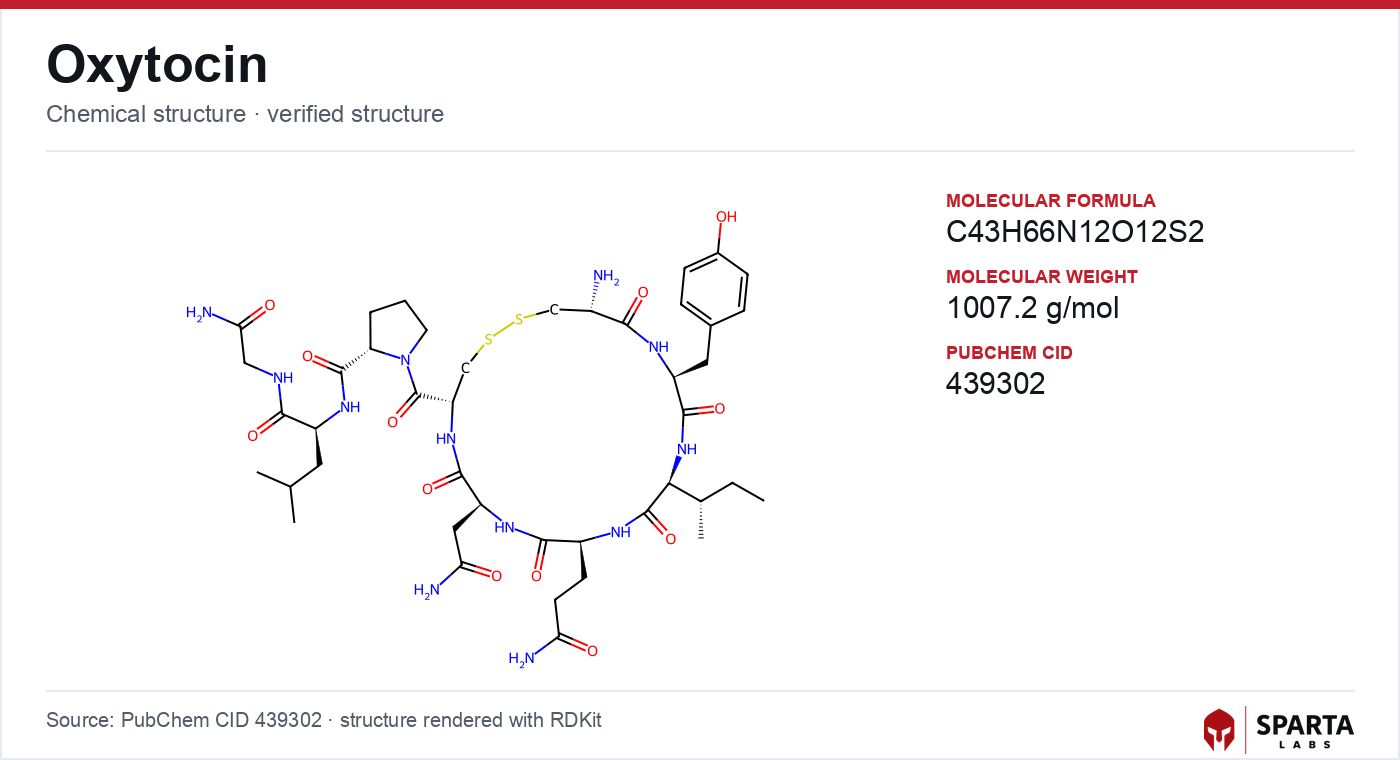
Figure: chemical structure of Oxytocin.
From Pituitary Extracts to a Named Activity (1895–1910)
The prehistory of oxytocin lies in the study of the posterior pituitary as an endocrine organ. In 1895, George Oliver and Edward Schäfer reported that an extract of the posterior pituitary lobe, administered intravenously to experimental animals, produced a marked pressor response, establishing that the tissue contained pharmacologically active material [1]. The observation was significant less for what it revealed about any single molecule than for demonstrating that a discrete gland harbored potent circulating agents.
A distinct activity emerged in 1906, when Henry Dale observed that posterior pituitary extracts produced rapid, forceful contraction of the uterus in preparations from pregnant animals [1]. This uterotonic action was recognized as separable in character from the pressor effect, though the field long entertained the possibility that a single substance underlay the full spectrum of observations. Dale's finding drew the immediate attention of obstetric physiology because of its bearing on the mechanics of labor.
The pharmacological portrait was completed in 1910, when Ott and Scott reported that comparable posterior pituitary preparations stimulated milk ejection from the mammary gland of lactating animals [1]. The coexistence of uterotonic activity, milk-ejection activity, and a pressor effect in the same crude extract created a puzzle that would take four decades to resolve: whether these actions reflected one molecule or several.
Resolving Two Hormones and Fractionating the Extract (1920s–1940s)
Through the 1920s and 1930s, the central experimental problem was purification. Investigators sought to concentrate and separate the active principles from a chemically ill-defined extract. The pivotal advance came in 1928, when Oliver Kamm and colleagues at Parke, Davis & Company reported the separation of the oxytocic and pressor activities into distinct fractions [1]. This fractionation supplied the first strong experimental evidence that two separate molecular entities, later named oxytocin and vasopressin, accounted for the previously commingled pharmacological profile. The preparations were still not single chemical species, but the conceptual framework of two hormones was now grounded in data.
This period frames a recurring theme in neuropeptide history: activity was named and used pharmacologically long before its molecular identity was known. A comparable pattern of delayed structural resolution appears in the record of other hypothalamic signaling peptides, as discussed in the kisspeptin-10 discovery and research history article. In oxytocin's case, the gap between recognized activity (1906) and defined structure (1953) spanned nearly half a century.
Du Vigneaud, Sequence, and the First Synthetic Peptide Hormone (1953)
The structural resolution of oxytocin was accomplished in the laboratory of Vincent du Vigneaud at Cornell University Medical College. Building on peptide-chemistry methods including partial hydrolysis and chromatographic separation, du Vigneaud's group worked through purified posterior pituitary material during the late 1940s and early 1950s.
In 1953, du Vigneaud, Ressler, and Trippett published in the Journal of Biological Chemistry the complete amino acid sequence of oxytocin together with a proposal for its cyclic structure: nine residues, Cys-Tyr-Ile-Gln-Asn-Cys-Pro-Leu-Gly(NH₂), closed by a disulfide bridge between the two cysteines [2]. This established oxytocin as the first polypeptide hormone to have its primary sequence determined, and it defined the six-residue disulfide ring and three-residue tail that remain the structural hallmarks of the neurohypophysial hormone family.
Findings from research models do not establish safety or efficacy in humans. Sparta Labs makes no claims about the use of this compound.
Later the same year, du Vigneaud and colleagues reported the total chemical synthesis of a compound matching the proposed sequence, published in the Journal of the American Chemical Society [3]. The synthetic material displayed hormonal activity indistinguishable from the natural product, making oxytocin the first polypeptide hormone ever assembled by chemical synthesis. The dual achievement, sequence plus synthesis within a single year, is one of the foundational events in modern biochemistry.
The Nobel Committee recognized the work at the highest level, awarding Vincent du Vigneaud the 1955 Nobel Prize in Chemistry "for his work on biochemically important sulphur compounds, especially for the first synthesis of a polypeptide hormone." Beyond the prize, the synthesis had a practical consequence that shaped everything after: it converted oxytocin from an extract of variable composition into a defined chemical entity that could be manufactured, characterized, and analytically verified. That transition from biological extract to synthetic standard is the direct ancestor of the analytical specifications described in the companion oxytocin sourcing and verification standards article.
Structure-Activity Work and Analog Chemistry
The availability of a synthetic route did more than confirm a structure; it opened systematic structure-activity research. Because chemists could now vary individual residues, they prepared analogs to probe which positions governed receptor binding, uterotonic activity, and pharmacokinetic behavior. Substitutions at the disulfide ring and at the tripeptide tail proved especially informative in mapping the determinants of activity across the oxytocin and vasopressin family, whose members differ by only a small number of residues yet display distinct receptor profiles.
This analog work established the conceptual groundwork for later receptor pharmacology. The molecular details of how the mature ligand engages its receptor, as reconstructed from binding studies and structural data, are surveyed in the companion oxytocin mechanism of action article.
Regulatory Milestones and the Clinical Record
The synthesis of oxytocin of defined chemical identity enabled formulation development for clinical use, and oxytocin's regulatory footprint is a distinguishing feature of its history relative to most research peptides. Synthetic oxytocin, marketed as Pitocin, received US Food and Drug Administration approval under NDA 018261 for obstetric use [4]. The indications stated in the current prescribing information include antepartum initiation or stimulation of labor, adjunctive management of incomplete or inevitable abortion, and postpartum management of uterine hemorrhage and atony [4].
A separate intranasal formulation, Syntocinon Spray, received FDA clearance prior to 1982 for post-delivery milk letdown. The manufacturer withdrew it from the US market in 1995 for commercial reasons; FDA records indicate no safety findings precipitated the withdrawal [4]. The existence of a decades-long approved clinical record means oxytocin carries an unusually large published pharmacokinetic and safety literature for a compound also studied in research settings, a data foundation that supports the mechanistic work discussed in the oxytocin research overview.
From Reproduction to a Broader Research Landscape
For much of the twentieth century, oxytocin research centered on the reproductive axis. From the 1980s onward, that scope widened substantially as investigators mapped oxytocin receptor (OXTR) expression beyond the uterus and mammary gland, including cardiac tissue and brain regions such as the hypothalamus, amygdala, hippocampus, and nucleus accumbens, and identified oxytocin production in non-hypothalamic tissues including the heart [1,5].
Gimpl and Fahrenholz (2001) consolidated this expanding field in a comprehensive Physiological Reviews article cataloguing the molecular pharmacology of the OXTR system, including receptor structure, G-protein coupling, regulation of expression, and species differences [5]. For two decades it served as the reference framework for OXTR mechanistic research and remains a standard citation in the literature.
The structural era arrived with Waltenspühl and colleagues (2022), who reported cryo-electron microscopy structures of the active human oxytocin receptor bound to oxytocin at 3.2 Å resolution in Nature Communications [6]. The work provided direct atomic-resolution visualization of ligand-receptor contacts and identified a Mg²⁺ coordination complex as a previously uncharacterized feature of receptor activation, advancing the field beyond what radioligand binding and mutagenesis alone could resolve. Camerino's 2023 historical review situated these developments within the seventy-year trajectory from du Vigneaud's synthesis to contemporary cardiac and neural research [1].
Research into oxytocin's roles in cardiovascular physiology, neuroendocrine regulation, and neural-circuit modulation remains active across preclinical and early-stage human investigation. Research-grade oxytocin acetate is offered by Sparta Labs with batch-specific certificate of analysis and third-party analytical verification.
References
-
Camerino C. The long way of oxytocin from the uterus to the heart in 70 years from its discovery. Int J Mol Sci. 2023;24(3):2556. PMID: 36768879. PMCID: PMC9916674. DOI: 10.3390/ijms24032556. Available at: View on PubMed
-
du Vigneaud V, Ressler C, Trippett S. The sequence of amino acids in oxytocin, with a proposal for the structure of oxytocin. J Biol Chem. 1953;205(2):949–957. PMID: 13129273. Available at: View on PubMed
-
du Vigneaud V, Ressler C, Swan JM, Roberts CW, Katsoyannis PG, Gordon S. The synthesis of an octapeptide amide with the hormonal activity of oxytocin. J Am Chem Soc. 1953;75(19):4879–4880. DOI: 10.1021/ja01115a553. Available at: Full text via DOI
-
US Food and Drug Administration. Pitocin (oxytocin injection, USP) synthetic: prescribing information. NDA 018261. Available at: Source: accessdata.fda.gov
-
Gimpl G, Fahrenholz F. The oxytocin receptor system: structure, function, and regulation. Physiol Rev. 2001;81(2):629–683. PMID: 11274341. DOI: 10.1152/physrev.2001.81.2.629. Available at: View on PubMed
-
Waltenspühl Y, Ehrenmann J, Vacca S, Thom C, Medalia O, Plückthun A. Structural basis for the activation and ligand recognition of the human oxytocin receptor. Nat Commun. 2022;13(1):4153. PMID: 35851571. PMCID: PMC9293896. DOI: 10.1038/s41467-022-31325-0. Available at: View on PubMed
Disclaimer. Statements in this article have not been evaluated by the Food and Drug Administration. This compound is not intended to diagnose, treat, cure, or prevent any disease. Sparta Labs sells research-use-only materials. Content is provided for educational and informational purposes only and does not constitute medical advice. Consult a qualified medical professional for any health concerns.
Frequently asked questions
When was oxytocin first discovered?
The earliest observations attributable to oxytocin date to 1895, when George Oliver and Edward Schäfer reported pressor effects from posterior pituitary extracts. Henry Dale demonstrated uterotonic activity from these preparations in 1906, and Ott and Scott identified milk-ejection properties in 1910. Oxytocin was not structurally characterized as a distinct peptide until du Vigneaud and colleagues published its amino acid sequence in 1953.
Why was oxytocin important to the history of peptide chemistry?
In 1953 Vincent du Vigneaud and colleagues reported both the complete amino acid sequence of oxytocin and its total chemical synthesis, making it the first polypeptide hormone to be sequenced and the first to be built by chemical synthesis. The synthetic material displayed hormonal activity indistinguishable from the natural product. This dual achievement was recognized with the 1955 Nobel Prize in Chemistry.
What is the regulatory history of oxytocin?
Synthetic oxytocin received FDA approval under NDA 018261 as Pitocin for obstetric indications including labor induction and postpartum hemorrhage management. A separate intranasal formulation, Syntocinon Spray, received FDA clearance prior to 1982 and was withdrawn from the US market in 1995 for commercial reasons, with FDA records indicating no safety findings precipitated the withdrawal.
How were oxytocin and vasopressin separated into distinct hormones?
In 1928 Oliver Kamm and colleagues at Parke, Davis and Company reported the fractionation of posterior pituitary extracts into distinct oxytocic and pressor fractions, providing the first strong evidence that two separate molecular entities accounted for the previously commingled activities. Full structural identification of oxytocin and vasopressin as distinct nonapeptides was completed in du Vigneaud's laboratory in the early 1950s.
What are the most recent milestones in oxytocin receptor research?
Gimpl and Fahrenholz published a comprehensive 2001 review of the oxytocin receptor system in Physiological Reviews that framed OXTR pharmacology for two decades. In 2022, Waltenspühl and colleagues reported cryo-electron microscopy structures of the active human oxytocin receptor bound to oxytocin at 3.2 Å in Nature Communications, providing atomic-resolution detail of ligand-receptor contacts and a magnesium coordination feature of receptor activation.