
BPC-157 vs TB-500: A Structural and Pharmacological Comparison
A structural comparison of BPC-157 and TB-500, two synthetic research peptides, along their origin and derivation, amino-acid composition, molecular classification, and the type and regulatory status of their published research. Educational reference.
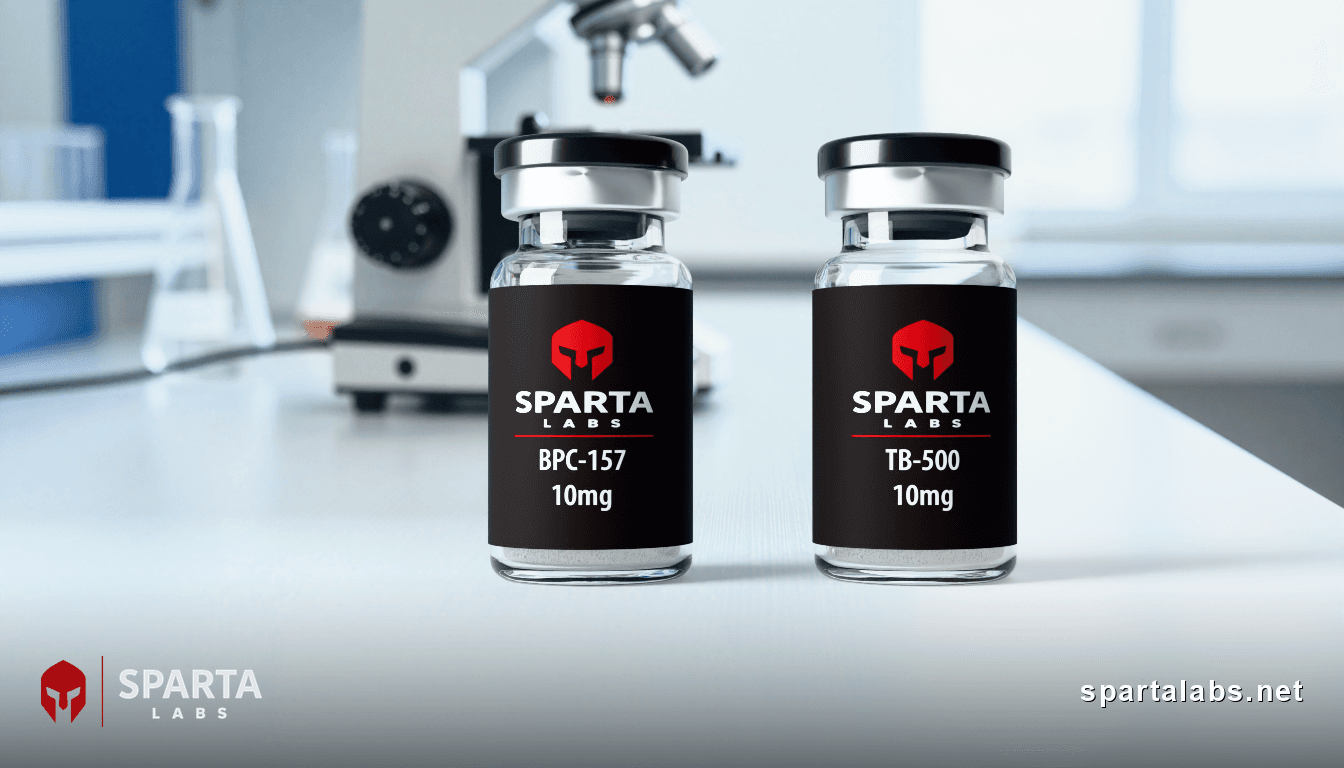
The search phrase "BPC-157 vs TB-500" pairs two synthetic peptides that are frequently discussed together in the research-peptide literature. This article compares BPC-157 and TB-500 strictly along the dimensions permitted for a structural comparison: their origin and derivation, amino-acid composition and sequence length, molecular classification, and the type and regulatory status of the published research associated with each. It does not compare their relative activity, does not describe any use, and does not draw a conclusion about which compound is preferable for any purpose. Both compounds are best understood as reference materials whose published record sits almost entirely in preclinical models. Neither BPC-157 nor TB-500 is approved by the U.S. Food and Drug Administration (FDA) for any human use.
BPC-157 profile
Origin and derivation
BPC-157 is a synthetic peptide. Its sequence corresponds to a fragment of a larger protein described in the research literature as a "body protection compound" reportedly isolated from, or associated with, gastric juice. In other words, BPC-157 is described as a partial sequence derived from a gastric protein rather than a naturally occurring peptide that circulates as such in the body. Because it is assembled by solid-phase peptide synthesis rather than extracted, the material studied under the name BPC-157 is a defined synthetic molecule.
The exact provenance of the parent protein and the derivation of the fragment are described in the primary literature associated with the compound. [1]
Amino-acid composition and sequence length
BPC-157 is commonly described as a pentadecapeptide, a peptide 15 amino acids in length. As a short, single-chain sequence, it lacks the size and secondary structure of a full protein and is characterized primarily by its linear amino-acid sequence. The specific residue sequence attributed to BPC-157 in the literature (reported as GEPPPGKPADDAGLV) should be confirmed against a primary source before publication. [1]
Molecular class
By molecular class, BPC-157 is a synthetic oligopeptide (a short-chain peptide). It is not a glycoprotein, not a large structured protein, and is not classified as a hormone. In the research literature it is generally grouped among small synthetic peptides studied in preclinical models rather than within an established pharmacological receptor class.
Published research and regulatory status
The published research associated with BPC-157 is predominantly preclinical: animal-model (largely rodent) studies and in-vitro work. Reports in this literature describe observations in injury and tissue models; any such findings are observations within those specific experimental systems and are attributed to the studies that reported them, not generalized here.
Findings from research models do not establish safety or efficacy in humans. Sparta Labs makes no claims about the use of this compound.
For example, a body of rodent-model literature has reported observations following BPC-157 administration in various tissue-injury models. [2] BPC-157 is not FDA-approved for any human indication, and its published human-clinical record is limited relative to its extensive preclinical literature. [3]
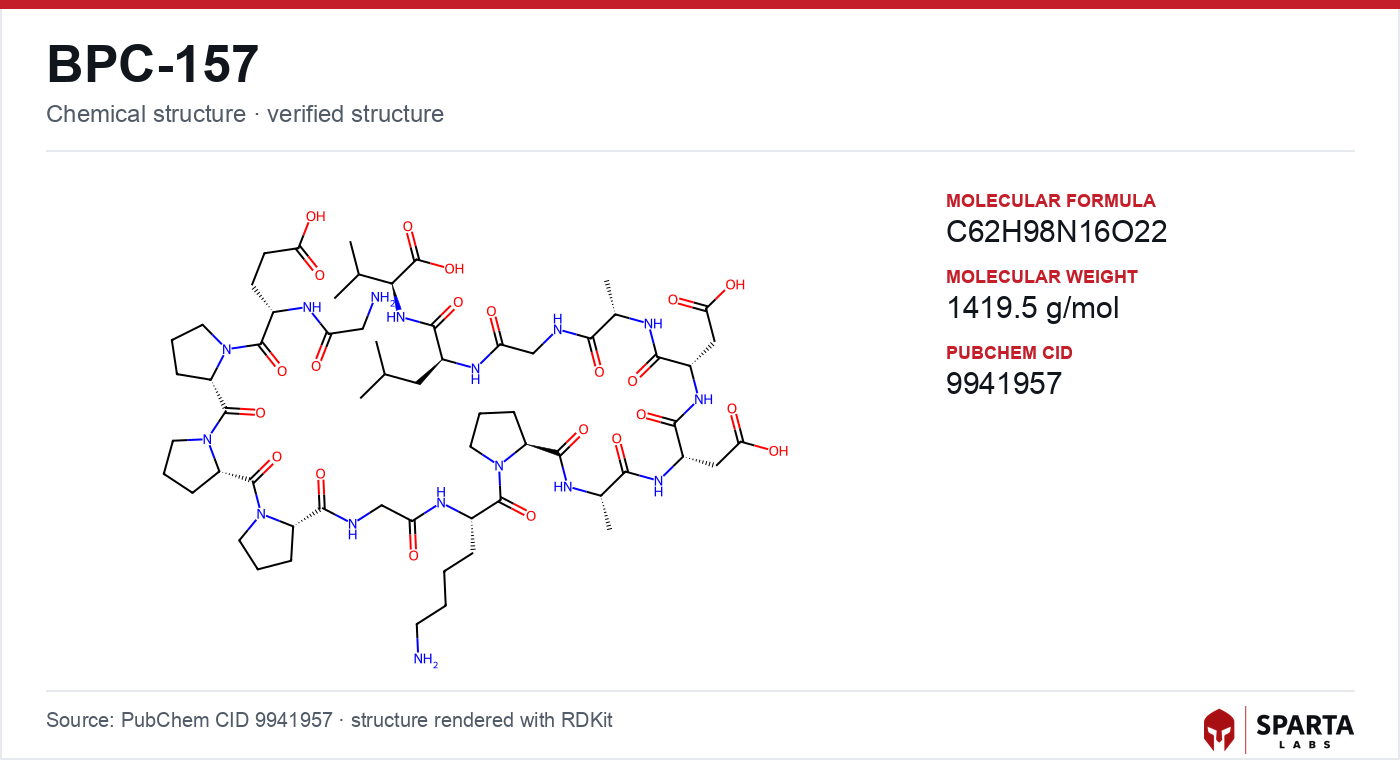
Figure: chemical structure of BPC-157 (one of the two peptides compared).
TB-500 profile
Origin and derivation
TB-500 is the name commonly applied in the research-peptide market to a synthetic peptide related to thymosin beta-4 (Tβ4). Thymosin beta-4 is a naturally occurring 43-amino-acid protein present in many mammalian tissues and described in the literature as an actin-binding protein. TB-500 is generally described as corresponding to an active fragment of, or a synthetic peptide related to, the thymosin beta-4 sequence. Importantly, "TB-500" (a research-market designation) and "thymosin beta-4" (the endogenous protein) are related but not strictly interchangeable terms, and the precise identity of a given TB-500 preparation is defined by its stated sequence. [4]
Amino-acid composition and sequence length
The parent molecule, thymosin beta-4, is described in the literature as 43 amino acids in length. Materials sold as TB-500 are frequently described as a shorter fragment associated with the actin-binding region of thymosin beta-4, rather than the full 43-residue protein. The specific residue sequence and length attributed to a TB-500 preparation should be confirmed against a primary source, because usage of the name varies. [4]
Molecular class
By molecular class, thymosin beta-4 is described as a member of the beta-thymosin family and as an actin-sequestering (actin-binding) protein. A TB-500 fragment derived from it is a synthetic peptide falling within that same structural lineage. As with BPC-157, TB-500 is a peptide rather than a small-molecule drug, but its lineage (a fragment related to a defined endogenous actin-binding protein) distinguishes its classification from BPC-157's gastric-protein-fragment origin.
Published research and regulatory status
Thymosin beta-4 and TB-500-type fragments appear in a preclinical literature spanning in-vitro and animal-model studies, and thymosin beta-4 itself has been examined in some human clinical research contexts as a distinct investigational agent. [5] The research-market compound "TB-500" is not FDA-approved for any human use. Any observations reported in the thymosin beta-4 / TB-500 literature are properties of those specific studies and models and are not restated as claims here. [6]
Structural comparison
Placed side by side, the two compounds differ along several structural and classificatory axes while sharing the broad category of "synthetic research peptide."
Derivation. BPC-157 is described as a fragment derived from a gastric-juice-associated protein, whereas TB-500 is described as a fragment related to thymosin beta-4, a well-characterized endogenous actin-binding protein. The two therefore trace to different parent proteins with different biological contexts in the literature.
Sequence length. BPC-157 is characterized as a pentadecapeptide (15 residues). Its parent context aside, it is a short linear peptide. TB-500's parent protein, thymosin beta-4, is a 43-residue protein, and TB-500 preparations are typically described as a shorter fragment of that sequence. The two named compounds thus differ in the length and in the size of the parent molecule from which each is described as derived. Exact residue counts for any specific preparation should be verified against the primary literature. [1,4]
Molecular class. Both are single-chain synthetic peptides rather than small-molecule compounds. They diverge in lineage: BPC-157 is generally treated as a stand-alone synthetic oligopeptide not assigned to an established endogenous protein family, while TB-500 sits within the beta-thymosin / actin-binding-protein lineage by virtue of its relationship to thymosin beta-4.
Structural character. As short peptides, neither is defined by the complex tertiary folding of a large globular protein; each is characterized primarily by its amino-acid sequence. The salient structural distinction between them is one of sequence identity and parent-protein lineage rather than of gross molecular architecture.
Pharmacological class context
Neither compound is classified within a conventional receptor-agonist pharmacological class in the way that, for instance, a GLP-1 receptor agonist is. BPC-157 is described in the literature as a synthetic gastric-protein-derived peptide studied in preclinical models. TB-500 is described in relation to thymosin beta-4, whose reported molecular role in the literature centers on actin binding. These are descriptions of molecular lineage and reported biochemistry drawn from primary sources, not statements of clinical pharmacological effect, and any mechanistic detail should be attributed to the specific study reporting it. [1,4]
For structural background on each compound individually, see the corresponding overview articles in the Sparta Labs research library: the BPC-157 research overview and the TB-500 research overview. Readers comparing peptide classes more broadly may also consult the library's other structural-comparison articles.
References
The following references were verified against primary and official sources. No authors, years, journals, or DOIs were fabricated.
- Sikiric P, Seiwerth S, Rucman R, Turkovic B, Rokotov DS, Brcic L, et al. Stable gastric pentadecapeptide BPC 157: novel therapy in gastrointestinal tract. Curr Pharm Des. 2011;17(16):1612-1632. View on PubMed (doi:10.2174/138161211796196954; PMID: 21548867): describes BPC 157 as a pentadecapeptide (sequence GEPPPGKPADDAGLV) stable in and derived in relation to human gastric juice.
- Staresinic M, Sebecic B, Patrlj L, Jadrijevic S, Suknaic S, Perovic D, et al. Gastric pentadecapeptide BPC 157 accelerates healing of transected rat Achilles tendon and in vitro stimulates tendocytes growth. J Orthop Res. 2003;21(6):976-983. View on PubMed (doi:10.1016/S0736-0266(03)00110-4; PMID: 14554208): representative rodent-model study reporting observations following BPC 157 administration.
- U.S. Food and Drug Administration. Certain Bulk Drug Substances for Use in Compounding That May Present Significant Safety Risks (Section 503A interim bulk drug substances list). Source: fda.gov: BPC-157 is not an FDA-approved drug; it appears on the interim compounding-bulks list rather than as an approved product.
- Goldstein AL, Hannappel E, Kleinman HK. Thymosin beta4: actin-sequestering protein moonlights to repair injured tissues. Trends Mol Med. 2005;11(9):421-429. View on PubMed (doi:10.1016/j.molmed.2005.07.004; PMID: 16099219): characterizes thymosin β4 as the major 43-amino-acid actin-sequestering protein; "TB-500" is marketed as a synthetic peptide corresponding to its actin-binding region.
- Guarnera G, DeRosa A, Camerini R. The effect of thymosin treatment of venous ulcers. Ann N Y Acad Sci. 2010;1194:207-212. View on PubMed (doi:10.1111/j.1749-6632.2010.05490.x; PMID: 20536470); see also ClinicalTrials.gov NCT00832091 (Study of Thymosin Beta 4 in Patients With Venous Stasis Ulcers). ClinicalTrials.gov record: thymosin β4 examined as a distinct investigational agent in human clinical research.
- U.S. Food and Drug Administration. Certain Bulk Drug Substances for Use in Compounding That May Present Significant Safety Risks (Section 503A interim bulk drug substances list). Source: fda.gov: neither the research-market "TB-500" fragment nor thymosin β4 is FDA-approved for any human use.
Frequently asked questions
What is the difference between BPC-157 and TB-500?
The two trace to different parent proteins. BPC-157 is described as a fragment derived from a gastric-juice-associated "body protection compound" protein, while TB-500 is described as a fragment related to thymosin beta-4, a well-characterized endogenous actin-binding protein. Both are single-chain synthetic peptides rather than small-molecule compounds.
How long are the BPC-157 and TB-500 sequences?
BPC-157 is commonly described as a pentadecapeptide, a peptide 15 amino acids in length. TB-500's parent protein, thymosin beta-4, is described in the literature as 43 amino acids in length, and materials sold as TB-500 are frequently described as a shorter fragment associated with its actin-binding region. Exact residue counts for any specific preparation should be verified against the primary literature.
What molecular class do BPC-157 and TB-500 belong to?
BPC-157 is a synthetic oligopeptide generally treated as a stand-alone peptide not assigned to an established endogenous protein family. TB-500 sits within the beta-thymosin, actin-binding-protein lineage by virtue of its relationship to thymosin beta-4. Neither compound is classified within a conventional receptor-agonist pharmacological class.
Are BPC-157 and TB-500 FDA-approved?
No. Neither BPC-157 nor the research-market compound "TB-500" is approved by the U.S. Food and Drug Administration for any human use. The published research associated with both sits almost entirely in preclinical models, and both appear on the FDA's Section 503A interim compounding-bulks list rather than as approved products.