
GLP-1, GLP-2, and GLP-3 (RT): A Structural Comparison of Incretin Research Peptides
A structural comparison of three synthetic incretin research peptides, described strictly at the level of receptor-target profile, molecular class, and regulatory status: the informal "GLP-1 / GLP-2 / GLP-3" shorthand refers to the count of engaged receptors. Educational reference.
The comparison of retatrutide vs tirzepatide vs semaglutide, sometimes framed by researchers and reference sources as GLP-1 vs GLP-2 vs GLP-3 according to the number of incretin- and glucagon-family receptors each molecule engages, is a question of receptor pharmacology and molecular architecture, not of outcome. This article surveys three synthetic peptide research materials and describes each strictly at the level of its receptor-target profile, its molecular class, and its regulatory status. Nothing here addresses use, benefit, efficacy, or any physiological outcome; the comparison is limited to what each molecule binds and how each is built.
The informal "GLP-1 / GLP-2 / GLP-3" shorthand used in some educational contexts refers to the escalating count of engaged receptors (one, two, or three) and should not be confused with the distinct endogenous hormone GLP-2, which is a separate intestinal peptide unrelated to this naming convention. In this article the shorthand is used only as a reader-facing label for the mono-, dual-, and tri-agonist receptor classes.
Regulatory and research-use framing
All three compounds are handled by Sparta Labs solely as research-use-only (RUO) materials. Two of the three, semaglutide and tirzepatide, hold FDA approval as pharmaceutical products under separate brand and generic identities. That approval is a regulatory fact about specific finished drug products, not a statement about the research material offered here and not a use recommendation of any kind. Retatrutide is described in the public record as an investigational compound that had not received FDA approval as of this writing [9]. The compounds are referred to below by their International Nonproprietary Names (INNs) because this is non-transactional educational reference content describing receptor pharmacology and molecular structure.
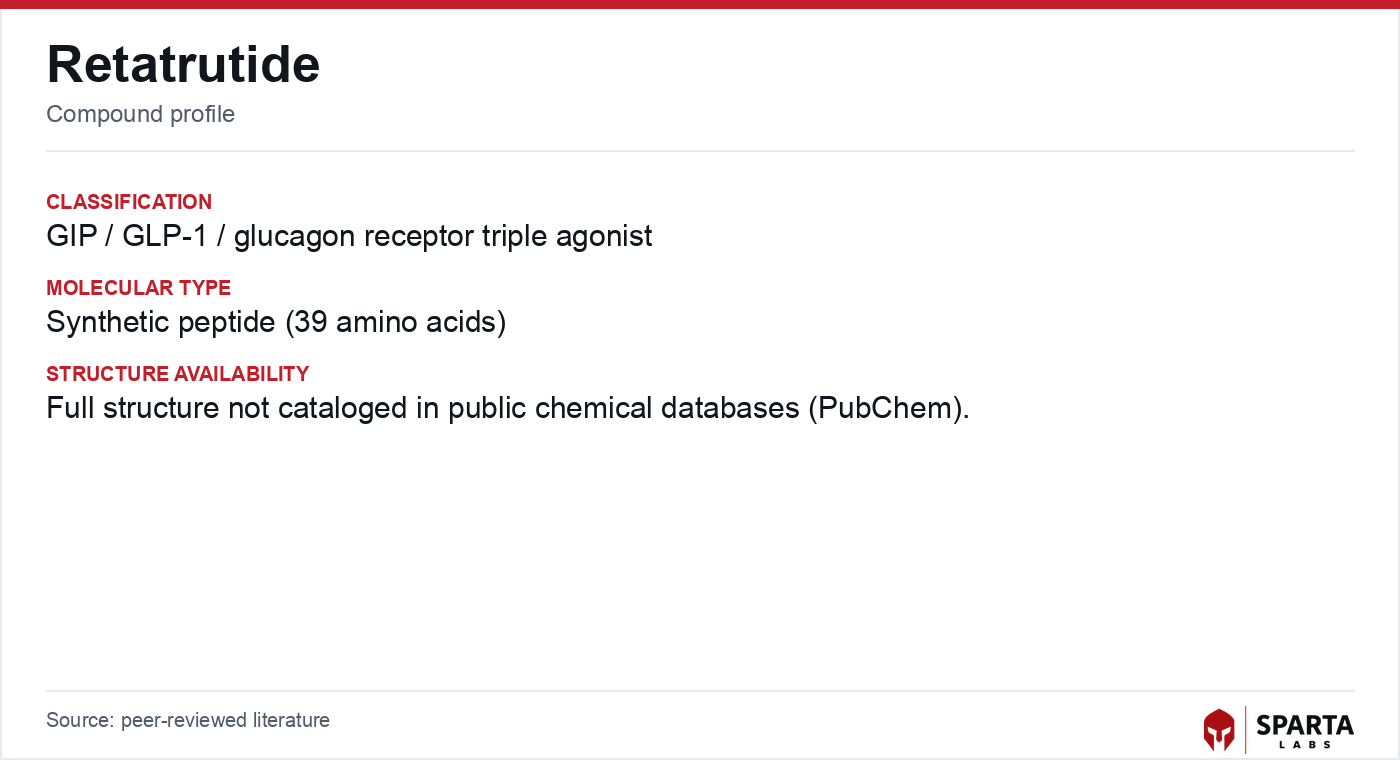
Figure: chemical structure of retatrutide (one of the compounds discussed).
Semaglutide: single GLP-1 receptor agonist (the "GLP-1" class)
Semaglutide is described in the pharmacological literature as a glucagon-like peptide-1 (GLP-1) receptor agonist: that is, a molecule whose defined pharmacological target is the single GLP-1 receptor [1].
Findings from research models do not establish safety or efficacy in humans. Sparta Labs makes no claims about the use of this compound.
Structurally, semaglutide is reported as an analog of the native human GLP-1 peptide backbone, modified from the parent sequence at select residues and bearing a fatty-acid (acylated) side chain attached via a linker, a design associated in the literature with altered plasma-protein binding characteristics [2]. Its molecular class is therefore an acylated GLP-1 analog peptide. Semaglutide has been the subject of FDA approval as a finished pharmaceutical product [3]; as noted, that status attaches to those drug products, not to RUO research material. The single-receptor research material in this class is listed under the class name GLP-1 SG from Sparta Labs.
Tirzepatide: dual GIP / GLP-1 receptor agonist (the "GLP-2" class)
Tirzepatide is characterized in the literature as a dual agonist engaging two receptors: the glucose-dependent insulinotropic polypeptide (GIP) receptor and the GLP-1 receptor [4]. In the informal counting shorthand this two-receptor profile is the "GLP-2" label, again referring to receptor count, not the GLP-2 hormone.
Structurally, tirzepatide is reported as a synthetic peptide built on a backbone related to the GIP sequence, engineered to cross-react with the GLP-1 receptor and likewise carrying a fatty-acid moiety [5]. Its molecular class is thus a GIP-based, acylated multi-receptor agonist peptide. Tirzepatide has also been the subject of FDA approval as a finished pharmaceutical product [6], with the same RUO caveat as above. The dual-agonist research material in this class is listed under the class name GLP-2 TZ from Sparta Labs.
Retatrutide: triple GIP / GLP-1 / glucagon receptor agonist (the "GLP-3" class)
Retatrutide is described in the literature as a triple agonist, a molecule reported to engage three receptors: the GIP receptor, the GLP-1 receptor, and the glucagon (GCG) receptor [7]. This three-receptor profile is the origin of the informal "GLP-3" label.
Structurally, retatrutide is reported as a synthetic peptide agonist whose sequence was engineered for balanced activity across the three named receptors, and which, like the other two, incorporates a fatty-acid modification [8]. Its molecular class is a multi-receptor (tri-agonist) analog peptide. In the public regulatory record retatrutide is described as investigational and, as of this writing, had not been approved by the FDA [9].
Structural and receptor-target comparison
The table below summarizes the three compounds strictly along receptor-target and molecular-structure axes. It contains no efficacy, potency, or outcome comparison of any kind.
| Attribute | Semaglutide ("GLP-1") | Tirzepatide ("GLP-2") | Retatrutide ("GLP-3") |
|---|---|---|---|
| Receptor-target class | Single-receptor agonist | Dual-receptor agonist | Triple-receptor agonist |
| Receptor(s) engaged (as reported) | GLP-1R | GIP-R + GLP-1R | GIP-R + GLP-1R + GCG-R |
| Reported backbone lineage | GLP-1 analog | GIP-based | Engineered multi-receptor peptide |
| Structural modification (as reported) | Acylated (fatty-acid side chain) | Acylated (fatty-acid side chain) | Acylated (fatty-acid side chain) |
| Molecular class | Acylated peptide analog | Acylated peptide multi-agonist | Acylated peptide tri-agonist |
| Regulatory status | FDA-approved as finished drug product(s) | FDA-approved as finished drug product(s) | Investigational (not FDA-approved as of writing) |
| Status here | Research-use-only material | Research-use-only material | Research-use-only material |
The single distinction the literature draws among these three at the pharmacological-class level is the count and identity of receptors each is reported to engage. This is a classification statement, not a ranking; the "GLP-1 / GLP-2 / GLP-3" shorthand is a stand-in for one, two, and three receptors respectively.
Pharmacological class context
All three sit within the broader family of incretin- and glucagon-family peptide receptor agonists. Semaglutide represents the mono-agonist end of that family as reported in the literature; tirzepatide adds a second receptor; retatrutide adds a third. The escalation is one of receptor breadth in the published characterizations of each molecule, and this article makes no comparative claim beyond that structural and receptor-target description.
For related structural background, see the library's overview articles on incretin-class peptide chemistry and on peptide acylation and half-life modification, and the mechanism-class reference on GLP-1 receptor pharmacology.
References
- Lau J, Bloch P, Schäffer L, Pettersson I, Spetzler J, Kofoed J, et al. Discovery of the once-weekly glucagon-like peptide-1 (GLP-1) analogue semaglutide. J Med Chem. 2015;58(18):7370-7380. View on PubMed (doi:10.1021/acs.jmedchem.5b00726; PMID: 26308095): primary discovery paper characterizing semaglutide as a GLP-1 receptor agonist.
- Lau J, Bloch P, Schäffer L, Pettersson I, Spetzler J, Kofoed J, et al. Discovery of the once-weekly glucagon-like peptide-1 (GLP-1) analogue semaglutide. J Med Chem. 2015;58(18):7370-7380. View on PubMed (doi:10.1021/acs.jmedchem.5b00726; PMID: 26308095): same source; describes semaglutide as an acylated GLP-1 analog (fatty-diacid side chain via linker with backbone residue substitutions).
- U.S. Food and Drug Administration. Ozempic (semaglutide) injection: NDA 209637, original approval December 5, 2017. Drugs@FDA: Source: accessdata.fda.gov ; DailyMed label: DailyMed drug label: semaglutide is FDA-approved as finished drug products (Ozempic; also Rybelsus 2019, Wegovy 2021).
- Coskun T, Sloop KW, Loghin C, Alsina-Fernandez J, Urva S, Bokvist KB, et al. LY3298176, a novel dual GIP and GLP-1 receptor agonist for the treatment of type 2 diabetes mellitus: from discovery to clinical proof of concept. Mol Metab. 2018;18:3-14. View on PubMed (doi:10.1016/j.molmet.2018.09.009; PMID: 30473097): primary discovery paper characterizing tirzepatide (LY3298176) as a dual GIP/GLP-1 receptor agonist.
- Coskun T, Sloop KW, Loghin C, Alsina-Fernandez J, Urva S, Bokvist KB, et al. LY3298176, a novel dual GIP and GLP-1 receptor agonist for the treatment of type 2 diabetes mellitus: from discovery to clinical proof of concept. Mol Metab. 2018;18:3-14. View on PubMed (doi:10.1016/j.molmet.2018.09.009; PMID: 30473097): same source; describes the GIP-based, fatty-acid-acylated peptide backbone (full text open access at PMC6308032).
- U.S. Food and Drug Administration. Mounjaro (tirzepatide) injection, initial U.S. approval 2022; Zepbound (tirzepatide) injection: NDA 217806, approved November 8, 2023. DailyMed (Mounjaro): DailyMed drug label ; DailyMed (Zepbound): DailyMed drug label: tirzepatide is FDA-approved as finished drug products.
- Coskun T, Urva S, Roell WC, Qu H, Loghin C, Moyers JS, et al. LY3437943, a novel triple glucagon, GIP, and GLP-1 receptor agonist for glycemic control and weight loss: from discovery to clinical proof of concept. Cell Metab. 2022;34(9):1234-1247.e9. View on PubMed (doi:10.1016/j.cmet.2022.07.013; PMID: 35985340): primary discovery paper characterizing retatrutide (LY3437943) as a triple glucagon/GIP/GLP-1 receptor agonist.
- Coskun T, Urva S, Roell WC, Qu H, Loghin C, Moyers JS, et al. LY3437943, a novel triple glucagon, GIP, and GLP-1 receptor agonist for glycemic control and weight loss: from discovery to clinical proof of concept. Cell Metab. 2022;34(9):1234-1247.e9. View on PubMed (doi:10.1016/j.cmet.2022.07.013; PMID: 35985340): same source; describes retatrutide as a fatty-acid-acylated, GIP-backbone multi-receptor agonist peptide.
- U.S. National Library of Medicine, ClinicalTrials.gov. A study of retatrutide (LY3437943) in participants who have obesity or overweight (TRIUMPH-1), Phase 3: NCT05929066. ClinicalTrials.gov record: retatrutide is an investigational compound in Phase 3 trials and is not FDA-approved for any use.
Frequently asked questions
What does the "GLP-1 / GLP-2 / GLP-3" shorthand mean?
The informal shorthand refers to the escalating count of engaged receptors (one, two, or three) for the mono-, dual-, and tri-agonist receptor classes. It should not be confused with the distinct endogenous hormone GLP-2, which is a separate intestinal peptide unrelated to this naming convention. In this comparison it is used only as a reader-facing label for receptor count.
How many receptors does each compound engage?
Semaglutide is described as a single GLP-1 receptor agonist. Tirzepatide is characterized as a dual agonist engaging the GIP receptor and the GLP-1 receptor. Retatrutide is described as a triple agonist reported to engage the GIP receptor, the GLP-1 receptor, and the glucagon (GCG) receptor. The single distinction the literature draws at the class level is the count and identity of receptors each is reported to engage.
How do the molecular structures differ?
Semaglutide is reported as an analog of the native human GLP-1 backbone bearing a fatty-acid (acylated) side chain. Tirzepatide is reported as a synthetic peptide built on a backbone related to the GIP sequence and likewise acylated. Retatrutide is reported as a synthetic peptide engineered for balanced activity across three receptors, also incorporating a fatty-acid modification. All three are acylated peptides.
What is the regulatory status of these compounds?
Semaglutide and tirzepatide hold FDA approval as finished pharmaceutical products under separate brand and generic identities; that approval is a regulatory fact about specific finished drug products, not about research material. Retatrutide is described in the public record as an investigational compound that had not received FDA approval as of this writing. All three are handled solely as research-use-only materials here.